Three Chinese electric cars score five stars in the latest Euro NCAP tests, exposing a dramatic shift in the global race for automotive safety, writes ANNIE ALLEN
For decades, automotive safety was one of the strongest fortresses protecting the reputations of Europe’s established carmakers.
European manufacturers built their brands around engineering excellence, sophisticated technology and the ability to protect occupants when things went catastrophically wrong.
Then China arrived.
At first, Chinese carmakers were largely associated with inexpensive vehicles competing aggressively on price. Gradually, however, the newcomers began adding better styling, more technology, longer driving ranges and increasingly sophisticated electric powertrains.
Now they are attacking another powerful advantage of the established automotive order: safety.
The latest Euro NCAP crash-test results provide perhaps the clearest indication yet of how dramatically the landscape is changing.
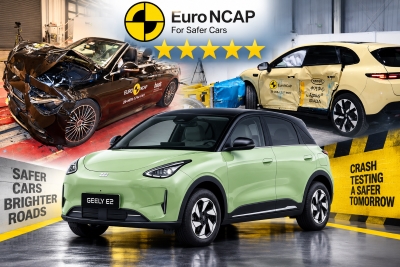
Three Chinese electric vehicles – the AION UT, GEELY E2 and Leapmotor B05, have each achieved the maximum five-star safety rating under Euro NCAP’s demanding 2026 assessment protocols.
Their achievement is significant not because a five-star rating automatically makes them safer than every European, Japanese or Korean rival, but because it demonstrates how quickly Chinese manufacturers have moved towards the safety standards expected of the world’s most demanding automotive markets.
The question is no longer whether Chinese manufacturers can build safe cars. The question is how quickly they can become safety leaders.
The transformation did not happen overnight.Chinese automotive safety has evolved considerably since Euro NCAP tested its first Chinese-manufactured vehicle in 2010. What was once largely a story of catching up has developed into increasingly fierce competition.
The latest generation of Chinese EVs is arriving in Europe with advanced driver-assistance systems, sophisticated collision-avoidance technology, strong occupant protection and extensive post-crash safety features.
And European consumers are buying them.
Chinese vehicles accounted for approximately 7 per cent of new-car sales in the European Union and almost 10 per cent in the UK last year. Since 2021, the number of Chinese vehicles assessed by Euro NCAP has risen almost tenfold.
That is no longer an insignificant presence.
It represents a rapidly expanding challenge to manufacturers that have dominated European roads for generations.
THREE FIVE-STAR STATEMENTS
The AION UT is a particularly revealing example.
The electric family hatchback achieved 91 per cent for Crash Protection, alongside 66 per cent for Safe Driving, 74 per cent for Crash Avoidance and 88 per cent for Post-Crash Safety.
Its performance was strong enough to secure five stars, although Euro NCAP identified weaknesses. The car relies heavily on its central touchscreen for important functions, while its speed-limit recognition system achieved only 68 per cent accuracy. It also lacks Child Presence Detection.
These criticisms are important because they demonstrate that five stars do not mean perfection.
Euro NCAP’s increasingly sophisticated testing is designed to identify precisely such weaknesses.
The GEELY E2, meanwhile, produced an impressive 79 per cent Safe Driving score, 72 per cent for Crash Avoidance, 86 per cent for Crash Protection and 95 per cent for Post-Crash Safety.
Physical controls for important driving functions and standard Child Presence Detection worked in its favour.
But again, there were weaknesses. Its automatic emergency braking system was inconsistent in some scenarios, while protection of the driver’s legs in a frontal offset crash was inadequate. Euro NCAP also identified partial seatbelt slippage involving the simulated 10-year-old child.
Then there is the Leapmotor B05.
Its 92 per cent Crash Protection score was among its strongest achievements. It also scored 77 per cent for Crash Avoidance and 89 per cent for Post-Crash Safety.
Its automatic emergency braking system performed exceptionally well in high-speed and junction scenarios, while its lane-departure prevention system was close to perfect.
The B05 also achieved maximum points in side-barrier and side-pole impacts.
Together, the three vehicles tell a compelling story: Chinese EV manufacturers are not simply importing inexpensive technology into Europe. They are increasingly engineering their vehicles around the safety expectations of the European market.
THE CUPRA QUESTION
Perhaps the most interesting comparison comes from Europe itself. The CUPRA Raval, a sporty electric supermini, was tested under exactly the same 2026 assessment framework. With standard equipment, it achieved four stars.
That is not a poor result. Indeed, its physical crash protection was impressive, scoring 91 per cent, while Post-Crash Safety reached 95 per cent.
But the Raval’s overall rating rose to five stars when the optional Safety Pack was fitted.
Its Safe Driving score increased from 58 to 72 per cent, while Crash Avoidance rose from 66 to 77 per cent.
The result exposes an important new dimension of automotive safety. A vehicle’s ability to withstand a crash remains crucial, but modern safety increasingly begins before the impact.
Automatic emergency braking, lane-departure prevention, driver monitoring, junction assistance and other technologies are designed to prevent the crash altogether.
And this is where the latest Euro NCAP protocols are becoming particularly demanding.
THE PRICE OF SAFETY
The CUPRA result also raises another question: should sophisticated safety technology be optional?
Euro NCAP’s assessment indicates that the Raval’s optional Safety Pack substantially enhances its ability to respond to potential dangers.
From the manufacturer’s perspective, offering such equipment as an option can help keep the entry price competitive.
From the safety perspective, however, there is an obvious argument for making as much of this technology standard as possible.
That debate is likely to become more important as Chinese manufacturers increasingly compete on equipment levels.
Many Chinese EVs arrive with extensive technology as standard, allowing manufacturers to present a strong value proposition to consumers.
If safety systems become part of that proposition, established brands may find themselves under increasing pressure to follow.
It would be wrong, however, to reduce the latest Euro NCAP results to a simple China versus Europe contest.
The five-star ratings do not mean that the AION UT, GEELY E2 or Leapmotor B05 is universally safer than every European competitor.
Euro NCAP itself identified shortcomings in all three vehicles.
But that is precisely what makes the results significant.
The Chinese manufacturers are now being judged against the same rigorous benchmarks as their established competitors—and increasingly passing the test.
For Europe’s automotive giants, that changes the nature of the competition.
They can no longer rely solely on decades of brand heritage to convince consumers that European engineering automatically means superior safety.
The Chinese challengers are building their own evidence.
The implications extend beyond Europe.
As Chinese manufacturers expand into Africa, the Middle East, Latin America and other emerging markets, their European safety performance could become an important part of their global sales pitch.
Nigeria, for example, is already seeing growing interest in Chinese automotive brands and electric vehicles.
The significance of the Euro NCAP results, therefore, goes beyond European showrooms.
They provide a glimpse into the direction of the global automotive industry.
China has already become a dominant force in electric-vehicle manufacturing. Its manufacturers have demonstrated an ability to move rapidly from technology adoption to technological innovation.
Safety may be the next frontier.
The old automotive hierarchy is consequently being challenged on multiple fronts—price, electrification, technology, design, range and now safety.
Euro NCAP Programme Director Dr Aled Williams has acknowledged the dramatic evolution of Chinese automotive safety since the organisation’s first Chinese-manufactured vehicle test in 2010.
There is still room for improvement, particularly in areas such as occupant monitoring, emergency braking, physical controls and restraint systems.
But the trajectory is difficult to ignore.
Three Chinese EVs have just demonstrated that they can meet the maximum Euro NCAP rating under tougher testing conditions.
That does not crown China the new king of automotive safety.
It does something more important.
It shows that the safety advantage once closely associated with established automotive powers is no longer theirs alone.
The race has widened.
And with Chinese EV manufacturers now entering the competition with five-star safety credentials, Europe’s automotive giants may have discovered that their newest competitors are not merely coming for their market share.
They are coming for one of their most valuable reputations. The global automotive safety battle has entered a new phase. And this time, China is firmly in the fight.
©Copyright MOTORING WORLD INTERNATIONAL. All rights reserved. Materials, photographs, illustrations and other digital content on this website, may not be reproduced, published, broadcast, rewritten or redistributed in whole or in part without prior written permission from Motoring World International
Contact: editor@motoringworldng.com