For many Nigerian motorists, the word “recall” immediately sounds like bad news.
A recall notice may trigger fears that a vehicle is defective, unsafe or poorly manufactured. But in reality, a vehicle recall can mean something very different: the manufacturer has discovered a potential problem and is taking responsibility before it becomes a bigger one.
That distinction is particularly important in Nigeria, where thousands of vehicles on the roads are imported used cars, many of which have passed through several owners, workshops and countries before arriving here.
A recall is essentially a manufacturer’s proactive response to a potential safety or quality problem discovered in a particular vehicle model, component or production batch.
Instead of waiting for the affected component to fail on the road, the manufacturer asks owners to bring the vehicle in for inspection, modification, software updating or replacement of the affected part.
For motorists, the most important message is simple: a recall should not be ignored.
The Nigerian used-car problem
One of the biggest challenges facing Nigerian motorists is knowing whether a used vehicle has outstanding recall work.
A car imported from Europe, America, Asia or another African country may have been subject to a recall in its country of origin. Yet its Nigerian owner may never receive the notification.
The vehicle may have changed hands several times. It may also have been serviced exclusively by independent mechanics who have no direct access to the manufacturer’s recall database.
This creates a dangerous information gap.
A Nigerian motorist could therefore be driving a vehicle with an unresolved manufacturer recall without knowing it.
Your VIN could reveal the truth
The Vehicle Identification Number, commonly known as the VIN, is one of the most important pieces of information every vehicle owner should know.
The unique identification number can be used by an authorised dealer or manufacturer to determine the vehicle’s production details and, where applicable, whether there are outstanding recall campaigns.
For motorists who own relatively new vehicles, particularly those still supported by an authorised dealership network, checking the VIN during servicing can provide an additional layer of protection.
Owners of imported used vehicles should be particularly proactive.
Rather than waiting for a problem to develop, they can contact the authorised representative of the vehicle brand in Nigeria and ask for a VIN-based recall check.
A recall does not automatically mean a bad car
There is an important misconception Nigerian motorists need to overcome.
A recall does not necessarily mean that every vehicle of a particular model is dangerous or badly manufactured.
Modern vehicles contain thousands of components and increasingly sophisticated electronic systems. Manufacturers continuously monitor vehicles after they enter the market. Information from customers, dealerships, engineers, regulators and field experience can sometimes reveal a problem that was not identified during development or production.
A responsible manufacturer can then issue a recall to correct the problem.
In that sense, a recall can demonstrate that a manufacturer is prepared to act when a potential defect is identified.
And it should not cost you
When a vehicle is covered by an official manufacturer recall, the corrective work is generally carried out at no cost to the owner, subject to the terms of the particular recall campaign.
That may include the replacement of a defective component, software updates, inspections or other prescribed corrective work.
This is why motorists should be wary of paying a mechanic to carry out work that may actually be covered by an official recall.
The first step should be to establish whether the vehicle has an outstanding manufacturer campaign.
Why Nigerian motorists should care
Nigeria’s roads present enough challenges without motorists unknowingly driving vehicles with unresolved manufacturer safety issues.
The combination of imported used vehicles, multiple ownership, independent servicing and limited awareness of manufacturer recall systems makes recall awareness particularly important.
A vehicle that has spent years outside its original market may no longer have any connection with the dealership that originally sold it.
But its VIN remains its identity.
Don’t wait for the warning light
A recall-related problem may not necessarily announce itself with a dashboard warning light.
The issue could involve a component that operates normally for thousands of kilometres before a particular condition triggers the fault.
That is why waiting for symptoms can be the wrong strategy.
Nigerian motorists should periodically ask an authorised dealer or the manufacturer’s Nigerian representative whether their vehicle has any outstanding recall or technical campaign.
For imported used vehicles, this check should ideally form part of the vehicle-buying process.
The five-minute safety check
Before buying a used imported vehicle, insist on obtaining its VIN and checking its history as far as possible.
After purchase, keep the VIN and vehicle documentation safely.
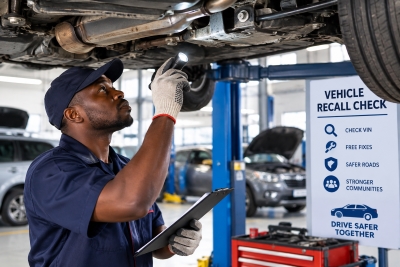
During servicing, ask the authorised dealer or representative to check whether there are outstanding manufacturer campaigns.
And if you receive a recall notification, don’t put it aside because the vehicle appears to be working perfectly.
A recall is often issued precisely because manufacturers want to fix a potential problem before the driver experiences it.
For Nigerian motorists, the lesson is clear: don’t fear the recall—investigate it.
The real danger may not be the recall itself, but driving a vehicle with an unresolved safety campaign simply because nobody told you about it.