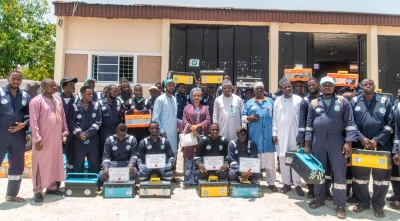
Two-week hands-on training in Borno equips technicians and young Nigerians with skills to power the country’s growing petrol-to-gas conversion drive
OLAOLU OWOEYE
Nigeria’s emerging CNG revolution is creating a new demand—not just for cheaper and cleaner transportation, but for skilled hands capable of converting, maintaining and repairing the vehicles that will drive the transition.
Against this backdrop, the National Automotive Design and Development Council (NADDC), in collaboration with Jennymond Systems Ltd., has trained 50 technicians and youths in Borno State in petrol-to-CNG vehicle conversion.
The two-week specialised programme, which ran from August 17 to August 28, 2026, combined intensive theoretical instruction with practical training in CNG conversion, vehicle diagnostics, installation, safety standards and maintenance.
The initiative comes as the Federal Government intensifies efforts to promote CNG as an alternative fuel for transportation.
But beyond the fuel itself lies a critical challenge: who will convert and maintain the growing number of CNG vehicles?
NADDC’s latest intervention is aimed at building that workforce.
The beneficiaries were trained by Jennymond Systems in the technical processes involved in converting suitable PMS-powered vehicles to CNG.
Rather than relying solely on classroom instruction, participants were given hands-on exposure to conversion procedures, vehicle diagnostics, installation techniques, safety protocols and the maintenance of alternative-fuel vehicles.
The practical emphasis is significant. CNG conversion requires proper installation, accurate diagnosis and strict adherence to safety procedures. Poorly executed conversions could compromise vehicle performance and safety.
For existing automotive technicians, the training offers an opportunity to upgrade their skills and enter an emerging area of vehicle servicing.
For the young participants, it opens the door to new employment and entrepreneurial opportunities.
At the end of the programme, the 50 beneficiaries received certificates of completion and empowerment tools to support the application of their newly acquired skills and enable them to provide CNG-related automotive services.
Nigeria’s CNG transition could create an entire new layer of automotive businesses.
Every additional CNG vehicle creates potential demand for trained conversion technicians, diagnostic specialists, maintenance personnel and workshop operators.
That makes technical capacity as important as fuel infrastructure.
The success of the transition will depend not only on the availability of natural gas and refuelling stations, but also on whether vehicles are correctly converted, properly maintained and safely operated.
NADDC’s programme therefore seeks to address both skills development and job creation, particularly among young Nigerians.
Holding the training in Borno also expands access to specialised automotive skills beyond the country’s traditional automotive centres.
The initiative aligns with the objectives of the Nigerian Automotive Industry Development Plan (NAIDP) and the Federal Government’s Renewed Hope Agenda, particularly cleaner energy adoption, youth empowerment, employment creation and technical development.
But the real measure of success will come after the certificates are issued—when the trainees begin applying their skills in workshops and businesses.
Nigeria’s CNG revolution will need more than gas, vehicles and filling stations. It will need a new generation of technicians who know exactly what to do with them.
©Copyright MOTORING WORLD INTERNATIONAL. All rights reserved. Materials, photographs, illustrations and other digital content on this website, may not be reproduced, published, broadcast, rewritten or redistributed in whole or in part without prior written permission from Motoring World International
Contact: editor@motoringworldng.com