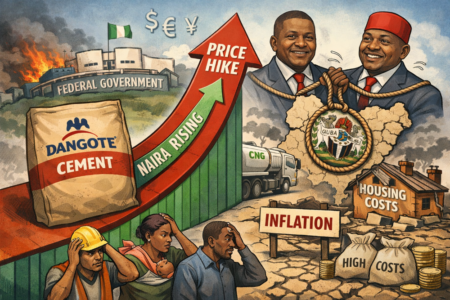
The planned increase in cement prices by Dangote Cement effective Friday, 27 February 2026, raises serious economic and moral questions at a time when Nigerians are yearning for relief from persistent inflationary pressures.
For months, the Federal Government has laboured to stabilise the macroeconomic environment, tightening monetary policy, reforming the foreign exchange regime, and pushing measures aimed at restoring investor confidence and strengthening the naira. A firmer naira should logically reduce the cost burden of imported inputs such as machinery components, spare parts, gypsum additives, and other dollar-denominated obligations associated with cement production.
If the naira is appreciating, why should cement prices be rising?
Cement is not a luxury product; it is a foundational commodity that drives housing, infrastructure, and industrial development. Every upward adjustment reverberates across the construction value chain — from individual home builders to large-scale federal contractors. It ultimately pushes up rents, property prices, and the cost of public infrastructure funded by taxpayers.
It is also public knowledge that both Dangote Cement and BUA Cement have invested significantly in Compressed Natural Gas (CNG)-powered trucks for cement and fuel distribution. CNG remains considerably cheaper than diesel or petrol in Nigeria’s deregulated energy market. If logistics costs are easing due to cheaper fuel alternatives and exchange rate improvements, Nigerians deserve clear justification for yet another upward price review.
The structure of Nigeria’s cement industry compounds the concern. With the market largely dominated by Dangote and BUA, competitive pressure is limited. In such an environment, parallel price increases — regardless of formal coordination — can create the perception of market insulation from consumer realities. That perception erodes public trust.
The Federal Government cannot afford indifference. President Bola Ahmed Tinubu’s administration has made inflation control a central plank of its economic reform agenda. Construction is a key economic driver. Escalating cement prices directly counteract efforts to moderate housing costs and infrastructure spending.
Regulatory bodies such as the Federal Competition and Consumer Protection Commission (FCCPC) must urgently examine the basis for this increase. This is not a call for arbitrary price fixing, but for transparency and accountability in a sector critical to national development.
Private enterprises exist to make profit, and profitability is legitimate. However, when dominant firms operate in a strategic sector that directly influences inflation, their pricing decisions carry national consequences. Economic reforms demand shared responsibility.
At a time when Nigerians are absorbing the effects of subsidy removal, energy tariff adjustments, and food inflation, increasing cement prices sends the wrong signal. It risks undermining both public confidence and the Federal Government’s broader anti-inflation strategy.
If the naira is strengthening and distribution costs are falling due to CNG adoption, manufacturers must provide convincing justification for any price increase.
Anything less appears not as business necessity, but as resistance to the nation’s economic stabilization efforts.
©Copyright MOTORING WORLD INTERNATIONAL. All rights reserved. Materials, photographs, illustrations and other digital content on this website, may not be reproduced, published, broadcast, rewritten or redistributed in whole or in part without prior written permission from Motoring World International
Contact: editor@motoringworldng.com