Nigeria may be sitting on the biggest industrial opportunity in its post-independence history. Yet, few policymakers appear to recognize it.
As federal and state governments intensify collaboration on trade, investment and industrialisation, one sector deserves urgent attention: the automotive industry.
The reason is simple.
The African Continental Free Trade Area (AfCFTA) has changed the rules of the game.
For decades, Nigeria has been Africa’s biggest automotive market. But being a market is not the same thing as being a manufacturing power. Nigeria imports. Others produce. Nigeria consumes. Others export.
That equation must change.
AfCFTA has created a single African market of more than 1.4 billion people with a combined GDP exceeding $3.4 trillion. According to the World Bank, the agreement could add as much as $450 billion to Africa’s economy by 2035 and boost intra-African trade by over 80 percent.
The question is no longer whether Africa will industrialise.
The question is: who will lead the industrial revolution?
South Africa has already positioned itself. Morocco has moved aggressively. Egypt is expanding rapidly. Nigeria, despite possessing the continent’s largest population and one of its biggest economies, remains largely a spectator.
That should worry policymakers.
Africa’s automotive market is currently valued at over $30 billion and is projected to exceed $42 billion within a few years. Demand for passenger cars, buses, trucks, motorcycles and agricultural vehicles is rising across the continent.
Yet Africa still imports most of its vehicles.
This is where Nigeria’s opportunity lies.
Since the introduction of the National Automotive Industry Development Plan in 2013, Nigeria has licensed more than 30 assembly plants. Vehicle assembly operations now exist across several states. Local manufacturers are producing passenger vehicles, buses, trucks, motorcycles and specialised vehicles.
But there is a problem.
Nigeria’s automotive policy has been designed almost entirely around the domestic market.
That strategy has reached its limit.
High inflation, weak purchasing power and expensive financing continue to constrain vehicle demand. No country becomes an automotive powerhouse by relying solely on its domestic consumers.
Successful automotive nations export.
South Africa produces over 500,000 vehicles annually and exports to more than 150 countries. Morocco now earns over $14 billion annually from automotive exports, making the sector its biggest export earner.
Nigeria’s domestic market is larger than both countries combined.
So why are we not competing?
The answer is not a lack of potential.
It is a lack of strategy.
The current collaboration between the Federal Government and state governments provides an opportunity to change course.
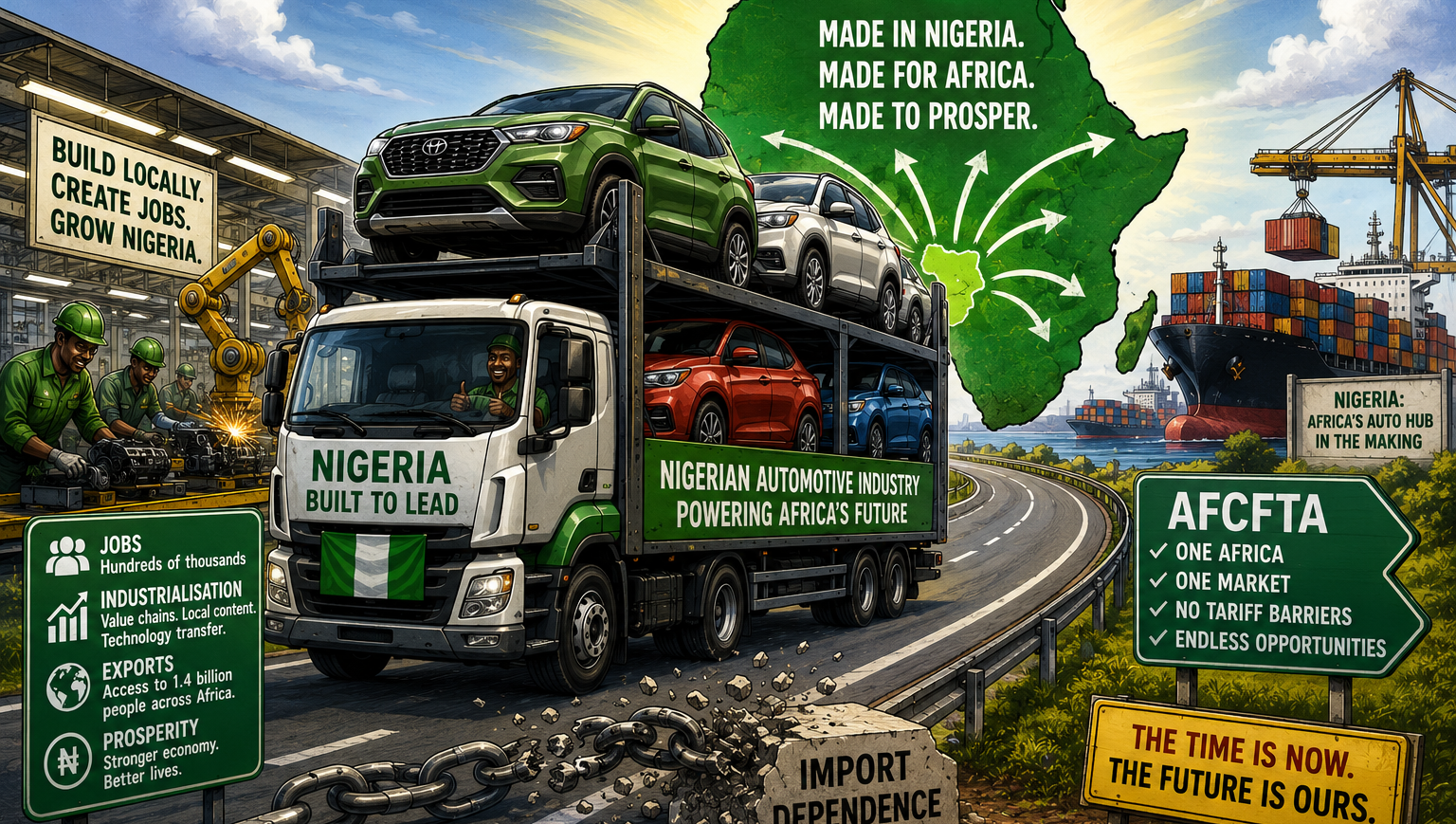
Nigeria urgently needs a National AfCFTA Automotive Export Strategy.
The objective should be clear: transform Nigeria from Africa’s biggest automotive market into one of Africa’s biggest automotive manufacturing and export hubs.
States must become partners in this mission.
Lagos and Ogun can serve as passenger vehicle manufacturing and export corridors. Kaduna can focus on commercial vehicles and agricultural equipment. Anambra and Kano can become centres for components, aftermarket products and industrial support services.
More importantly, Nigeria must stop thinking of automotive manufacturing simply as vehicle assembly.
An average automobile contains more than 30,000 components.
That means opportunities for steel manufacturers. Tyre companies. Battery producers. Glass manufacturers. Plastic processors. Upholstery makers. Electronics companies. Logistics operators.
In other words, automotive industrialisation creates entire industrial ecosystems.
This is why every major industrial economy invests heavily in the sector.
The Federal Government should therefore establish an Automotive Export Promotion Fund dedicated to helping manufacturers secure export certification, develop African markets, participate in trade fairs and overcome logistics barriers.
The country should also leverage CANEX 2026 and IATF 2027 to launch a continental “Made-in-Nigeria Automotive Export Initiative.”
Nigeria should not attend these events merely to exhibit.
Nigeria should attend to sell.
Most importantly, government policies must become predictable. Investors do not build billion-dollar factories on political promises. They invest based on policy certainty, fiscal stability and long-term vision.
The forthcoming National Council on Industry meeting in Enugu offers an opportunity to place automotive industrialisation at the centre of Nigeria’s economic agenda.
AfCFTA is not merely another trade agreement. It is Africa’s industrial revolution opportunity.
Nigeria can either become one of its architects. Or remain one of its customers.
The choice, ultimately, belongs to policymakers.
©Copyright MOTORING WORLD INTERNATIONAL. All rights reserved. Materials, photographs, illustrations and other digital content on this website, may not be reproduced, published, broadcast, rewritten or redistributed in whole or in part without prior written permission from Motoring World International
Contact: editor@motoringworldng.com