ANNIE ALLEN (UK Bureau Chief)
Kia Corporation has raised the stakes in the electric commercial vehicle market with the unveiling of its new PV7 electric van at IAA Transportation 2026 in Hannover, Germany.
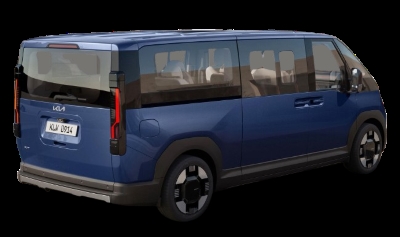
The PV7 is the second model in Kia’s dedicated all-electric Platform Beyond Vehicle (PBV) range, following the PV5, and is designed to take the Korean automaker deeper into the rapidly evolving light commercial vehicle (LCV) market.
Available in Cargo and Passenger versions, the PV7 combines electric power, generous interior space, fast charging and advanced connectivity, targeting businesses and mobility operators ranging from logistics and fleet companies to shuttle operators, tourism businesses and small and medium-sized enterprises.
Kia plans to launch the PV7 in Korea and Europe in 2027, with more variants and markets expected to follow.
“The PV7 marks the next step in our journey toward personalised mobility,” said Ho Sung Song, President and CEO of Kia.
According to him, the vehicle brings together application-specific hardware, business-oriented software and dedicated PBV services to create what Kia describes as a complete business solution.
The PV7 builds on the foundation laid by the PV5, which was named the 2026 International Van of the Year, but takes the concept to a larger scale with greater capacity and a wider range of possible applications.
At the centre of the PV7 is Kia’s dedicated E-GMP.S electric vehicle architecture, incorporating a flat-floor design that maximises interior space and provides greater flexibility for different body styles and conversions.
Kia has structured the PV7 around three key areas—hardware, software and service—with the objective of making the vehicle more than just a means of transportation.
Its business-oriented software package includes the Kia Business Solutions Portal, designed to assist fleet operators with vehicle management, charging, maintenance and daily operations. Fleet Management Systems and connected vehicle-data APIs are also intended to give operators greater visibility over their vehicles and improve operational efficiency.
Kia is equally targeting vehicle uptime. Its dedicated uptime services use real-time monitoring, predictive diagnostics and proactive maintenance management to help reduce operational disruptions.
The electric powertrain is another major attraction.
The PV7 comes with a choice of 71.5kWh and 96.2kWh NCM battery packs, while its electric motor can deliver up to 200kW of power and 420Nm of torque to the front wheels.
The Long Range Cargo version is capable of travelling more than 460km on a single charge under the WLTP cycle, potentially making it suitable for longer commercial operations.
Its 800-volt architecture also enables rapid charging. Using a 350kW DC fast charger, the battery can be charged from 10 to 80 per cent in the mid-20-minute range, reducing downtime for commercial operators.
In another practical innovation, Kia has equipped the PV7 with dual charging ports—a front AC/DC charging port and an optional rear-side AC charging port.
The PV7 Cargo is particularly aimed at logistics, delivery, fleet and SME operations. Depending on configuration, it is available globally in two- and three-seat versions.
The Cargo Long version offers up to 6.1 cubic metres of cargo space, while the High Roof version increases capacity to 8.0 cubic metres.
Payload capacity reaches 1,165kg in the Long version and 1,200kg in the Compact, while the Long version has a 550mm loading height and can accommodate up to three Euro pallets.
Kia has also introduced a dedicated heavy-load driving mode, which adjusts vehicle behaviour according to payload conditions to help maintain stable driving performance.
Practicality extends to the loading area, where customers can specify different floor materials depending on their business requirements. They can also choose between a full-open twin-swing tailgate for loading in confined areas and a conventional lift-up tailgate.
The vehicle’s Smart Walk Away function automatically closes the power sliding door when the driver walks away with the smart key, while remote cargo-door status monitoring allows operators to check the condition of the doors.
For passenger transport, the PV7 Passenger offers a completely different proposition.
Designed for crew transportation, shuttle services, rental operations, tourism and family use, it accommodates up to nine occupants globally and up to 11 in Korea, depending on configuration.
The seven-seat version features long-rail easy-remove seats, allowing the interior to be rapidly reconfigured. The nine-seat model can also be specified with or without a fourth row.
Rear climate control, USB-C charging ports and additional storage are designed to improve passenger comfort during longer journeys.
The PV7 also pushes Kia’s connected-vehicle technology further with Pleos Connect, an Android Automotive OS-based system offering connected navigation, flexible screen layouts, an application marketplace and over-the-air software updates.
Its Gleo AI voice assistant enables natural-language control of vehicle, navigation and messaging functions, bringing an increasingly smartphone-like digital experience into the commercial vehicle.
For businesses operating tools and electrical equipment away from conventional power sources, the PV7’s Vehicle-to-Load (V2L) capability allows the vehicle to supply electricity to equipment and other devices through interior and exterior outlets.
Safety has also received significant attention. The PV7 comes with a comprehensive suite of advanced driver-assistance systems and safety technologies, including a seven-airbag system.
Among them is Pedal Misapplication Safety Assist 2.0, designed to help reduce the risk of unintended acceleration resulting from incorrect pedal operation.
Kia says the PV7 is only the beginning of a much larger PBV strategy. Following its 2027 launch, the company plans to expand the PV7 range to 23 variants, while the larger PV9 is scheduled to join the lineup in 2029.
“The PV7 has been developed to give customers the flexibility to adapt as needs evolve,” said Sangdae Kim, Executive Vice President and Head of Kia’s PBV Business Division.
With its combination of long-range electric power, substantial cargo capacity, rapid charging, AI connectivity and business-focused services, the PV7 represents Kia’s attempt to redefine what an electric commercial vehicle can do—turning the van from a simple transport machine into a connected and adaptable business tool.
©Copyright MOTORING WORLD INTERNATIONAL. All rights reserved. Materials, photographs, illustrations and other digital content on this website, may not be reproduced, published, broadcast, rewritten or redistributed in whole or in part without prior written permission from Motoring World International
Contact: editor@motoringworldng.com