FEMI OWOEYE
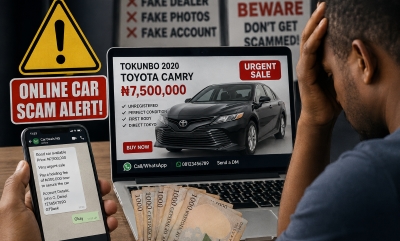
As economic pressures continue to squeeze Nigerian households, the search for cheaper cars online is growing rapidly. But behind some of the attractive prices and seemingly genuine vehicle adverts lurks a dangerous new threat: AI-powered car scams capable of wiping out a buyer’s savings in minutes.
Fraudsters are becoming increasingly sophisticated, using artificial intelligence to create convincing vehicle photographs, dealership profiles, social-media accounts, documents, voice recordings and even video calls.
For Nigerian car buyers, the warning is simple: that “too-good-to-be-true” car deal on Facebook, Instagram, WhatsApp or an online marketplace could be a carefully engineered trap.
The New Face of Online Car Fraud
In the past, fake car adverts were often easy to identify. Poor-quality photographs, spelling mistakes, suspicious phone numbers and unrealistic claims gave scammers away.
Not anymore.
With generative AI and digital editing tools, criminals can now produce professional-looking adverts that appear to come from legitimate dealerships. They can copy a genuine dealer’s logo, photographs, contact details and online identity—and create a convincing but completely fake sales operation.
A scammer may even send a polished video of the vehicle or communicate using a cloned voice to make the transaction appear genuine.
The result? A Nigerian buyer can transfer millions of naira for a vehicle that does not exist—or one the fraudster has no authority to sell.
Five Red Flags Nigerian Buyers Must Never Ignore
1. “Pay Now Before Someone Else Takes It”
This is one of the oldest tricks in the book.
The scammer claims several people are interested and demands an immediate deposit to “secure” the vehicle.
Stop.
A genuine seller should not need to manufacture panic before allowing you to conduct basic checks.
2.The Car Is Far Away—but the Price Is Unbelievable
A scammer may advertise a Toyota, Lexus, Mercedes-Benz or SUV significantly below prevailing market prices.
The explanation could be anything: “urgent sale”, “owner travelling”, “bank repossession”, “customs auction” or “company clearance”.
Before believing the story, compare the price with several established Nigerian dealers.
If the price is dramatically below the market, investigate before you celebrate.
3.You Are Asked to Pay a “Holding Fee”
Requests for money to “hold” a vehicle should immediately raise suspicion, particularly when payment is demanded into a personal bank account.
Do not assume that because the account name looks like a person’s name, the seller is legitimate.
Verify the business, physical address, ownership and payment details independently.
4.The Seller Avoids Physical Inspection
This is a major warning sign.
The seller may repeatedly claim the vehicle is at another location, the office is closed, the driver is unavailable or the car cannot be inspected until payment is made.
Walk away.
For an expensive purchase, insist on seeing the vehicle physically and independently verifying its documents.
5.“It Belongs to a Bank, Customs or Government Agency”
Nigerians should be particularly careful with adverts claiming to offer vehicles seized by Customs, repossessed by banks or being sold by government agencies.
Do not rely on WhatsApp messages, forwarded documents or social-media adverts as proof.
Verify the alleged auction or seller directly through the institution concerned.
Verification Can Save You
Interestingly, the same technology being exploited by fraudsters can also help buyers investigate suspicious sellers.
Before paying, search the dealer’s name, telephone numbers, business name and social-media accounts. Look for customer complaints, reviews and warnings.
Check whether the company’s physical address exists. Call the business using a number obtained independently—not just the number supplied by the person selling the vehicle.
Most importantly, do not allow a beautiful advert to replace due diligence.
Buy the Car, Not the Story
Nigerian motorists should remember that buying a vehicle online is not simply a matter of finding a good photograph and negotiating a price.
A serious buyer must establish:
- Who actually owns the vehicle?
- Where is the vehicle physically located?
- Is the seller a genuine dealer?
- Do the chassis/VIN and documents correspond?
- Is the vehicle free from outstanding claims or encumbrances?
- Has it been independently inspected?
- Is the seller’s business physically verifiable?
- Is the payment account genuinely connected to the seller?
And never allow pressure from a seller to override these checks.
The Golden Rule
Never transfer a large sum of money simply because an online seller says the deal will disappear if you delay.
A genuine vehicle will still be worth buying after proper verification.
In today’s AI-powered scam environment, Nigerian car buyers must understand one crucial reality:
Scammers are no longer necessarily looking like scammers.
They may look like professional dealers. Their adverts may look genuine. Their photographs may be perfect. Their documents may appear authentic. Their voices may sound familiar.
But before you send your hard-earned money, verify the seller, inspect the car and confirm the documents independently.
Because when the supposed “bargain” turns out to be a scam, the cheapest car can become the most expensive mistake you ever made.
©Copyright MOTORING WORLD INTERNATIONAL. All rights reserved. Materials, photographs, illustrations and other digital content on this website, may not be reproduced, published, broadcast, rewritten or redistributed in whole or in part without prior written permission from Motoring World International
Contact: editor@motoringworldng.com