…Carloha could tap emerging market as Nigeria moves towards decentralized policing
FEMI OWOEYE
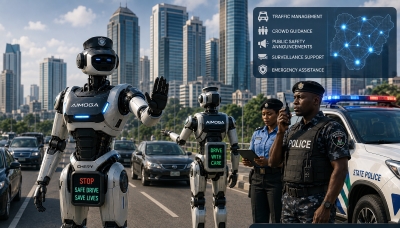
As Nigeria moves closer to constitutional reforms that could introduce state police and decentralise the country’s policing architecture, an unlikely technology from China could soon attract attention: humanoid police robots developed by Chery’s robotics subsidiary, AiMOGA Robotics.
The development comes at a critical moment for Nigeria, where the proposed establishment of state police is expected to give states greater responsibility for policing, traffic management, public safety and grassroots security.
AiMOGA Robotics, incubated by Chery in January 2025, is already moving beyond the automobile industry into artificial intelligence and robotics. According to Reuters, the company has delivered more than 3,000 robots globally, including about 2,000 overseas, and operates in more than 60 countries and regions.
The company is also preparing for a potential initial public offering to raise funds for technology development and expansion, while targeting deliveries of 10,000 robots globally next year.
More significantly for Nigeria, AiMOGA has already developed humanoid police robots. About 110 units have reportedly been deployed across several Chinese cities to assist with traffic management, crowd guidance and public-safety awareness campaigns.
AiMOGA President Zhang Guibing said traffic management emerged as a promising application because traffic officers frequently work in harsh conditions, including extreme weather, air pollution and environments where they face the risk of accidents.
That experience could have particular relevance to Nigeria.
Traffic congestion, difficult working conditions and manpower shortages remain major challenges in many Nigerian cities. A robotic system capable of directing traffic, communicating public-safety messages, guiding crowds or supporting officers in controlled environments could potentially become a useful supplement to conventional policing.
The proposed state-police structure could make the opportunity even more significant.
With states potentially assuming greater responsibility for security and policing, governments may need new technologies to improve the effectiveness of relatively limited manpower. Rather than replacing police officers, robots could serve as force multipliers, handling repetitive or hazardous duties while human officers focus on intelligence gathering, investigation, emergency response and crime prevention.
Possible applications in Nigeria could include traffic control, crowd management at major events, public-safety announcements, monitoring of restricted areas, assistance at transport terminals and road-safety campaigns.
For Carloha Nigeria, Chery’s Nigerian franchisee, the development could represent an opportunity that extends well beyond conventional automobile sales.
Carloha could explore discussions with Chery and Nigerian authorities on whether selected AiMOGA technologies could be adapted for the Nigerian environment, particularly for state governments, police authorities and traffic-management agencies.
Such an initiative could potentially begin with controlled pilot programmes in major cities, allowing Nigerian authorities to evaluate the technology’s effectiveness, cost, reliability, security and public acceptance before any large-scale deployment.
The opportunity is particularly interesting because Chery is increasingly evolving from a conventional vehicle manufacturer into a broader intelligent-mobility company, combining automobiles, artificial intelligence, autonomous technologies and robotics.
For Nigeria, the emerging Chery-AiMOGA technology could therefore coincide with one of the country’s biggest policing reforms in decades.
However, any deployment would require strong safeguards covering privacy, surveillance, data protection, accountability and the limits of autonomous technology. Robots should complement trained officers, not replace human responsibility for sensitive law-enforcement decisions such as arrests, use of force and criminal investigations.
If properly regulated, Nigeria’s transition towards state policing could create an unexpected new market for artificial intelligence and robotics.
For Carloha, it could also provide an opportunity to introduce Nigerians not only to Chery vehicles, but to a much broader vision of intelligent mobility, public safety and the future of policing.
©Copyright MOTORING WORLD INTERNATIONAL. All rights reserved. Materials, photographs, illustrations and other digital content on this website, may not be reproduced, published, broadcast, rewritten or redistributed in whole or in part without prior written permission from Motoring World International
Contact: editor@motoringworldng.com