ANNIE ALLEN (UK Bureau Chief)
American farmers are being crushed by soaring diesel prices as the war in Iran sends shockwaves through the food supply chain, threatening to push grocery bills even higher ahead of November’s midterm elections.
For farmers racing against time to harvest their crops, the Trump administration’s war in Iran is turning an already expensive season into a financial nightmare.
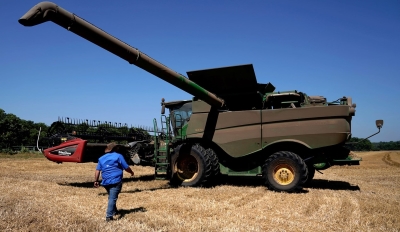
In northeast Missouri, Addie Yoder, a corn, soybean and cattle farmer, operates two combines, three semi-trucks and several tractors during the harvest season.
One combine alone consumes about 300 gallons of diesel.
With fuel prices hitting record highs, Yoder said her only option is to slash other expenses and hope the numbers add up.
In southeast South Dakota, soybean, corn and cattle farmer Drew Peterson faces an even more brutal reality. He expects to spend as much as $1,500 every day fuelling just one combine—double last year’s cost.
“You can’t just say, well, diesel is expensive, I’m not going to harvest,” Peterson said. “You’ve just got to make it work in your budget.”
But for farmers already battling thin profit margins, making it work could mean taking on more debt, cutting investment or watching hard-earned earnings disappear into fuel tanks.
Across the United States, diesel prices have surged during the height of harvest season, raising fears that the cost of putting food on American tables could soon become another casualty of the Iran conflict.
The average US diesel price reached a record $6.29 per gallon this week, up 68 per cent from $3.74 a year ago, according to Energy Information Administration data.
Global fuel supplies have been squeezed by the US-Israeli war on Iran and Ukrainian attacks on Russian refineries, adding pressure to an energy market already straining under geopolitical disruption.
The consequences extend far beyond the farm.
“THE MAJORITY OF OUR FOOD MOVES ON TRUCKS”
David Ortega, an economist at Michigan State University, warned that higher diesel prices raise costs at every stage of the food supply chain—from harvesting crops to transporting food to supermarkets.
“The majority of our food moves on trucks and those trucks use diesel,” Ortega said.
That means higher fuel bills for farmers, higher transport costs for trucking companies and, ultimately, greater pressure on consumers already struggling with the cost of living.
US consumer food prices rose 2.7 per cent year-on-year in August, according to the latest Consumer Price Index.
With November’s midterm elections approaching, rising grocery bills could further intensify voter concerns about household finances.
FUEL BILLS SPIRAL OUT OF CONTROL
Even farmers using tax-exempt off-road diesel are struggling to escape the fuel crisis.
Wayne Gularte, who grows vegetables on approximately 600 acres near Gonzales, California, said his fuel costs have jumped about 40 per cent, from roughly $5 to $7 per gallon.
His response? Bringing old gasoline-powered tractors from the 1950s back into service and parking one of his diesel pickups.
“The only money we can make is the money we save,” Gularte said.
According to Michael Langemeier, an economist at Purdue University, fuel costs for corn farmers are up $11 per acre from last year, while soybean farmers face an additional $7 per acre.
Those figures may appear small on paper, but multiplied across hundreds or thousands of acres, they can quickly become a crippling burden.
And the damage may not stop with this harvest.
Nick Paulson, an agricultural economist at the University of Illinois, warned that elevated fuel prices could push up the cost of seed and fertiliser next year, further squeezing farm profitability.
“The concern is that $6-plus per gallon diesel is going to start to put some inflationary pressures on everything else,” Paulson said.
“ADDITIONAL DEBT FOR THE FARM”
For many farmers, there is little left to cut.
Jon Paul Driver, a hay farmer near Spokane, Washington, and second vice president of the Washington Farm Bureau, said farmers have already tightened their belts.
“Any increase in fuel right now is additional debt for the farm,” Driver said.
The pressure has reached Washington.
US Senator Roger Marshall, a Republican from Kansas, asked Agriculture Secretary Brooke Rollins in a September 11 letter to provide temporary relief to farmers facing substantial unplanned fuel costs during one of the most diesel-intensive periods of the year.
A USDA spokesperson said the agency was “not leaving any stone unturned” in addressing high diesel prices. Rollins said in a September 15 Newsmax interview that more announcements on the issue would follow in the coming weeks.
But farmers facing immediate bills cannot harvest promises.
FOOD PRICES COULD BE THE NEXT VICTIM
The impact of the fuel crisis may soon become visible in grocery aisles.
Ortega said higher transport costs could push up prices of produce, dairy and meat, particularly products requiring refrigerated trucking.
Retailers may temporarily absorb some increases, while existing freight contracts could delay the full impact. But those protections may only postpone the pain.
Dean Croke, principal analyst at DAT Freight & Analytics, said refrigerated trailer rates for transporting apples and pears from Washington State’s Yakima Valley have reached a four-year high, with the harvest season only halfway over.
Transport costs for produce leaving California have risen between 40 and 120 per cent from a year ago, he said. In some California cities, diesel prices have exceeded $8 per gallon.
For independent truckers, who typically pay fuel costs upfront, the situation is becoming increasingly dangerous.
Croke warned that the industry could soon see “diesel price-driven bankruptcies” among trucking firms.
As the Iran war continues to squeeze global fuel supplies, America’s farmers and truckers are being forced to pay the price.
And if the pressure continues, consumers may be next in line.
©Copyright MOTORING WORLD INTERNATIONAL. All rights reserved. Materials, photographs, illustrations and other digital content on this website, may not be reproduced, published, broadcast, rewritten or redistributed in whole or in part without prior written permission from Motoring World International
Contact: editor@motoringworldng.com