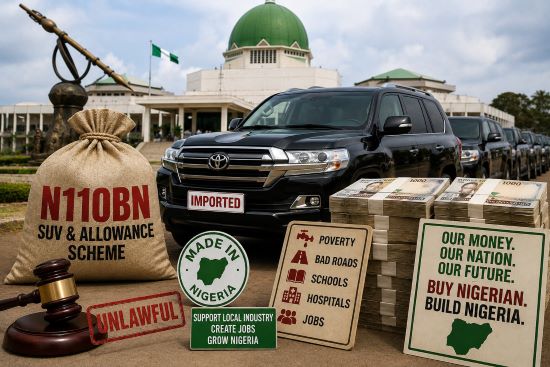
The recent court judgment declaring the National Assembly’s N110 billion SUV and allowance scheme unlawful should serve as more than a legal rebuke. It should trigger a national conversation about prudence, patriotism and accountability in public spending.
For far too long, Nigeria’s lawmakers have treated the procurement of brand-new luxury vehicles at the beginning of every legislative cycle as an entitlement rather than a necessity. The practice has become a ritual of excess, repeated every four years with little regard for economic realities or public perception.
One fundamental question remains unanswered: Why should legislators require a fresh fleet of vehicles every four years?
Modern automobiles, particularly those acquired brand new and maintained according to manufacturers’ specifications, do not become obsolete after four years. Across the world, government agencies, corporations and private individuals use vehicles efficiently for six, eight, ten years and even longer. A properly serviced vehicle remains reliable, functional and presentable long after a single legislative tenure.
In a nation grappling with inadequate infrastructure, underfunded schools, struggling hospitals and widespread poverty, replacing nearly new vehicles every four years is difficult to justify. It reflects a troubling disconnect between the governing class and the citizens they represent.
Even more disturbing is the persistent preference for imported vehicles. If lawmakers must use official vehicles, those vehicles should be sourced from Nigeria’s local automotive assembly plants. Anything less amounts to an economic contradiction.
Government cannot claim to support industrialisation while its highest public institutions continue to patronise foreign manufacturers. Every imported vehicle purchased with taxpayers’ money exports jobs, encourages capital flight and weakens local manufacturing capacity. Meanwhile, Nigerian assembly plants struggle for patronage, investment and economies of scale.
The National Assembly should be leading the campaign for local content, not undermining it. Lawmakers cannot pass policies encouraging automotive development while simultaneously spending public funds on imported alternatives.
A simple policy should suffice: official vehicles should be retained for as long as they remain serviceable, and whenever replacement becomes necessary, priority must be given to vehicles assembled in Nigeria.
Patriotism is not measured by speeches on the floor of parliament. It is demonstrated through choices. One of those choices is whether public funds create jobs in Nigeria or abroad.
The era of automatic SUV purchases every four years must end. The court has spoken on legality. Nigerians must now insist on common sense, fiscal responsibility and economic patriotism.
©Copyright MOTORING WORLD INTERNATIONAL. All rights reserved. Materials, photographs, illustrations and other digital content on this website, may not be reproduced, published, broadcast, rewritten or redistributed in whole or in part without prior written permission from Motoring World International
Contact: editor.motoringworldng@motoringworldng.com