For thousands of British motorists, the next MOT could bring costly repairs, disrupted journeys and a difficult choice: repair or replace their ageing vehicles. But where are motorists most at risk, and why? New research exposes Britain’s worst-performing areas, raising troubling questions about road conditions, vehicle maintenance and the escalating cost of keeping cars roadworthy, reports MATILDA OWOEYE.
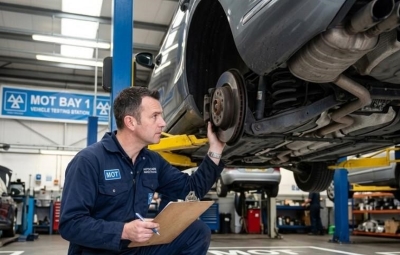
For many motorists, the nightmare begins with a routine visit to the garage. The car goes in for its annual MOT test, but instead of receiving a certificate, the owner gets a frightening list of defects and a repair quotation that could swallow hundreds of pounds.
Suddenly, the family car becomes a financial liability. Commuting arrangements collapse, school runs become complicated, and the owner faces an uncomfortable question: How much is too much to spend keeping an ageing vehicle alive?
New research by damaged vehicle purchasing specialist Sell Your Problem Car has brought this dilemma into sharper focus, identifying areas of Britain with particularly high MOT failure measures.
The study, covering 55 selected local authorities, placed Slough at the top with a failure measure of 3.60%, followed by Bedford at 3.10% and Brighton and Hove at 2.95%.
North Northamptonshire ranked fourth at 2.79%, while neighbouring Peterborough completed the top five at 2.72%.
Together, the two neighbouring areas account for approximately 427,783 licensed cars, highlighting the scale of the motoring population potentially exposed to maintenance challenges.
However, the figures require careful interpretation. The percentages represent averages of postcode-level failure proportions within the research dataset, rather than the overall percentage of MOT tests failed in each authority.
The Hidden Enemy Beneath Your Tyres
While poor vehicle maintenance remains an important concern, damaged roads can quietly turn an otherwise serviceable car into an expensive mechanical problem.
Potholes, uneven surfaces and repeated impacts can damage tyres, suspension components and wheel alignment, sometimes without producing immediately obvious symptoms.
Sean Wright, a damaged car buyer at Sell Your Problem Car, warns that motorists who ignore early warning signs could be setting themselves up for expensive repairs.
According to Wright, unusual noises, vibrations and vehicles pulling to one side should trigger prompt mechanical inspection.
His advice is straightforward: motorists should avoid potholes where safely possible and investigate changes in vehicle handling before minor defects develop into serious problems.
Although the study does not establish that potholes caused the recorded MOT failure measures, the warning highlights an important relationship between road conditions and vehicle maintenance costs.
The Repair Bill Is Only the Beginning
An MOT failure can trigger a financial chain reaction extending far beyond the original mechanical defect.
Apart from replacement parts and labour charges, motorists may face retesting fees, alternative transport expenses and lost time while their vehicles remain off the road.
For families dependent on a single vehicle, even a few days without transport can disrupt work, education and other essential activities.
Wright advises motorists against authorising repairs without first understanding the full financial implications.
Drivers should request a clear explanation of the defects responsible for the failure, distinguish compulsory repairs from advisory items, and obtain an estimate covering parts, labour and any applicable retest charges.
They should also establish how long the repairs will take.
A quotation that initially appears manageable could become considerably less attractive once additional expenses are considered.
Repair It or Walk Away?
Perhaps the most difficult decision arises when an MOT failure exposes several serious defects in a vehicle already suffering recurring mechanical problems.
Imagine an ageing car worth £1,500 requiring £900 in immediate repairs, with further transmission or engine problems potentially waiting around the corner.
Would spending that money represent sensible maintenance or simply postpone an inevitable replacement?
Wright believes motorists should compare repair quotations against their vehicles’ current market values and assess whether the proposed work offers a lasting solution.
Repeatedly spending hundreds of pounds on a deteriorating vehicle may eventually become economically unjustifiable.
However, selling a car simply because it fails an MOT is not always the wisest decision. A relatively inexpensive repair could extend its useful life considerably, particularly where the engine, transmission and bodywork remain sound.
The crucial consideration is whether the total cost of keeping the vehicle roadworthy makes financial sense.
Even defective vehicles can retain resale value, making independent valuations worthwhile before owners commit to major expenditure.
A Warning Beyond Britain
Although the findings concern British motorists, the underlying lessons resonate strongly in countries such as Nigeria, where deteriorating road surfaces, expensive replacement parts and ageing vehicle fleets present additional ownership challenges.
Unlike Britain, where periodic MOT testing provides a structured system for identifying roadworthiness defects, vehicle inspection requirements and enforcement vary across Nigeria.
For Nigerian motorists, a neglected suspension fault or worn tyre may continue unnoticed until a breakdown, accident or costly mechanical failure occurs.
The economic consequences can be particularly severe when replacement components are imported and exchange-rate fluctuations push repair costs higher.
The British research therefore offers a broader lesson: preventive maintenance is often less expensive than waiting for mechanical trouble to become unavoidable.
Importantly, the study itself did not measure actual repair bills, retest costs or the number of motorists temporarily deprived of transport. Its findings should therefore be viewed as an indicator of geographical differences within the selected dataset, not proof that drivers in the five ranked areas face the highest repair expenses in Britain.
Nevertheless, the message for vehicle owners is unmistakable.
A car does not suddenly become expensive when it fails an inspection. In many cases, the financial trouble has been developing quietly through neglected maintenance, worsening mechanical defects and warning signs that went unheeded.
And when the garage finally delivers its verdict, the biggest question may no longer be whether the car can be repaired. It may be whether the owner can still afford to keep it.
©Copyright MOTORING WORLD INTERNATIONAL. All rights reserved. Materials, photographs, illustrations and other digital content on this website, may not be reproduced, published, broadcast, rewritten or redistributed in whole or in part without prior written permission from Motoring World International
Contact: editor@motoringworldng.com