FEMI OWOEYE
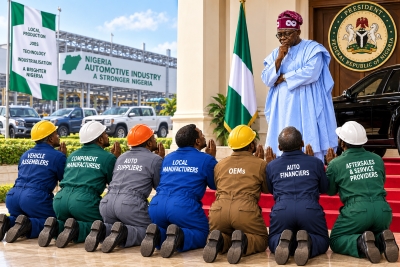
Nigeria cannot afford another automotive policy celebrated at stakeholder meetings, then abandoned when election campaigns seize the national agenda.
The 2026 reform effort deserves recognition. On September 3, NADDC convened industry stakeholders in Lagos to examine the Draft National Automotive Industry Bill, 2026. The proposal would give statutory backing to NAIDP’s incentives and protections, replace the existing institutional framework and transform the council into the National Automotive Design and Development Commission. Its ambitions include component manufacturing, electric mobility and stronger domestic supply chains. This goes beyond giving an old policy a new name.
Government has also tightened its Nigeria First procurement drive. September’s directive requires federal procuring entities to prioritise domestically assembled vehicles, with exceptions subject to official approval. In October, NADDC reported installed assembly capacity of 370,520 vehicles annually. That is productive potential Nigeria must turn into factory orders, employment and local value. Capacity, however, is not actual production.
Yet consultations and procurement circulars cannot substitute for durable legislation. Investors purchasing machinery, training workers and developing suppliers need confidence that today’s incentives will survive tomorrow’s administration.
Here, the state police campaign offers a compelling lesson in political urgency.
On October 23, the Presidency announced that 24 state assemblies had approved the constitutional amendment enabling a dual policing system, meeting the required threshold. That momentum demonstrates what coordinated executive and legislative commitment can achieve. Automotive reform deserves comparable determination, although its legislative route differs.
State policing is being advanced to strengthen protection of lives and property. Automotive legislation would strengthen protection of productive investment, industrial employment and economic capacity. Both concern national security: one confronts violence; the other helps prevent industrial decay and deepening dependence on imports.
The faded dominance of PAN and Volkswagen’s original Nigerian operations should haunt policymakers. Their histories warn that factories and famous badges cannot guarantee industrial survival.
But urgency must produce a workable law. NAMA’s recommendations deserve attention: predictable tariffs, practical component-development incentives, properly governed development funding and measurable obligations for investors. Public support should purchase verifiable production, jobs, skills and local content.

Publisher/CEO, Motoring World
Presidency, Industry Ministry, Justice Ministry and National Assembly are, therefore, urged to publish a coordinated timetable for final drafting, submission, hearings, passage and presidential assent. NADDC and BPP should publish quarterly procurement and production results. Affordable vehicle finance, reliable electricity and rigorous quality standards must accompany implementation.
It would be shameful to let this renewed effort disappear beneath campaign posters.
Give the auto bill the political velocity of state police reform before another generation inherits silent factories.
©Copyright MOTORING WORLD INTERNATIONAL. All rights reserved. Materials, photographs, illustrations and other digital content on this website, may not be reproduced, published, broadcast, rewritten or redistributed in whole or in part without prior written permission from Motoring World International
Contact: editor@motoringworldng.com