FEMI OWOEYE
As Nigeria celebrates Women’s Month, perhaps the greatest tribute to women is not another road safety campaign urging them to stay safe, but encouraging the rest of the driving public to emulate the discipline they often display behind the wheel.
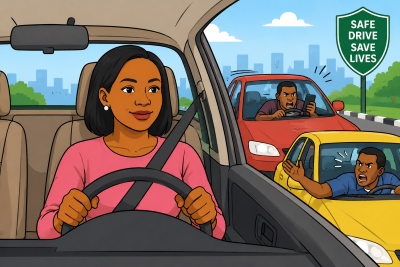
For years, road safety experts have observed that women generally drive with greater patience, caution and consistency—qualities that dramatically reduce the likelihood of crashes. While Nigeria does not yet maintain comprehensive gender-based crash statistics, road safety officials and fleet managers have repeatedly linked dangerous driving habits such as excessive speeding, reckless overtaking, aggressive driving and frequent traffic violations largely to male motorists.
This reality is reflected in Federal Road Safety Corps (FRSC) crash reports, where commercial vehicles, driven almost entirely by men, continue to account for a substantial share of fatal road crashes across the country.
But this is not about pitching men against women.
It is about identifying the driving behaviours that save lives and encouraging every Nigerian motorist to adopt them.
Women drivers are widely recognised for respecting speed limits, maintaining safe following distances, avoiding unnecessary risks and showing greater obedience to traffic regulations. Ironically, these are the very principles road safety authorities have spent decades trying to instill in Nigerian drivers.
Imagine the difference if these habits became the norm rather than the exception.
Nigeria’s frightening road crash figures could decline significantly, thousands of families could be spared the pain of losing loved ones, and our roads would become far safer for everyone.
The lessons go beyond private motorists. More women should be encouraged to take up leadership roles in fleet management, transport operations, driver training and road safety administration. Across many organisations, disciplined safety cultures built on structured driver education and strict operational standards have consistently resulted in fewer crashes and lower operating costs—areas where many female professionals have distinguished themselves.
Of course, safe driving is not determined by gender. Men can be just as responsible, disciplined and safety-conscious. The difference lies not in whether a driver is male or female, but in the choices made behind the steering wheel.
That is why Women’s Month offers Nigeria an opportunity to celebrate more than achievements in politics, business and leadership. It is also time to recognise women as quiet champions of safer roads.
Instead of dismissing women’s cautious driving style as a stereotype, the nation should embrace it as a proven road safety model worthy of emulation.
With thousands of Nigerians still dying annually in preventable road crashes, replacing aggression with patience, recklessness with discipline and speed with responsibility could become one of the country’s most effective road safety strategies.
If Nigerian motorists, especially commercial drivers, adopt these life-saving habits, everyone will benefit.
This Women’s Month, the most meaningful way to honour women may simply be to drive like the safest among them.
©Copyright MOTORING WORLD INTERNATIONAL. All rights reserved. Materials, photographs, illustrations and other digital content on this website, may not be reproduced, published, broadcast, rewritten or redistributed in whole or in part without prior written permission from Motoring World International
Contact: editor@motoringworldng.com