By JUAN ALEJANDRO BETTIZ (Filed from UAE)
A sparkling clean Tokunbo engine could hide a costly disaster. Across Nigeria, mechanics buy imported used engines on two reassuring words: “Fully tested.” When that engine starts knocking after installation, the customer returns furious—and the mechanic’s reputation takes the beating.
From Lagos to Kano, mechanics depend on dealers importing engines by the container. Yet when trouble strikes, the person who recommended and installed the engine often faces the consequences.
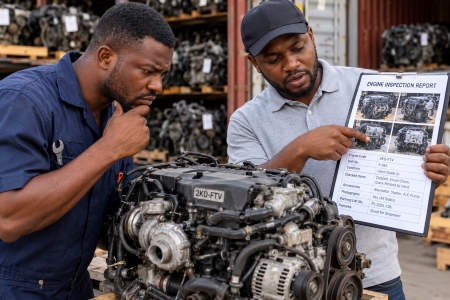
Protection starts with one demand: Show me the inspection report!
I export used engines from Guangzhou, China, to Nigeria and other African markets. I have a commercial interest in this business, but I also know what a credible inspection report should contain.
1.Engine Code: Don’t Buy the Wrong Heart
“Toyota 1.5” or “Hilux diesel” is not enough. Demand the specific engine code, such as 1NZ-FE or 2KD-FTV. This helps establish compatibility with the vehicle, transmission, electronics and wiring.
The report must identify the actual engine offered. A mismatch could become an expensive installation nightmare.
2.Tested—or Merely Turned?
In used-engine exports, inspection may involve cleaning, examining the exterior and manually rotating the crankshaft to check that the mechanism is not seized.
Useful? Yes. A comprehensive mechanical test? No. It does not establish cylinder compression, internal wear or running performance.
Ask which tests were performed and demand the results. If compression, leak-down or running tests were not conducted, the report should state this clearly.
3.Photographs Can Expose Trouble
Glossy catalogue pictures prove little. Demand clear photographs of the actual engine, showing its cylinder head, block, sump, timing cover, mounting points, identification markings and accessories.
Look for oil leaks, coolant stains, broken brackets and suspicious residue around the oil filler.
Photographs cannot prove internal soundness, but they can reveal warning signs before payment.
4.Match the Engine to Its Records
Every engine should have an identification or stock number matching its inspection photographs and packing list.
Without that connection, how can you confirm that the engine inspected overseas is the unit offered in Nigeria?
Proper documentation should make each engine traceable from inspection to delivery.
5.Beware of Missing Components
Identical engine codes do not guarantee identical packages.
One engine may include an alternator, starter motor and power-steering pump; another may exclude them.
Confirm exactly what comes with the purchase, particularly the engine control unit and wiring harness, which are frequently excluded.
Missing components can wipe out the savings that made the engine attractive.
6.Diesel Buyers: Watch Three Danger Zones
For engines such as Toyota’s 2KD and 1KD or Isuzu’s 4JB1, scrutinise the turbocharger, injectors and cylinder head.
These can generate substantial repair bills.
Photographs showing these components do not establish their condition. Where test results are unavailable, allow for workshop checks before promising trouble-free performance.
7.Investigate the Dealer’s Buying Process
Ask how the dealer sourced the engine.
Was the exporter identified? Were inspection records and photographs supplied before payment? Is there a documented invoice and traceable payment?
A dealer who skipped verification may unknowingly transfer the risk to you.
8.What Does “Grade A” Guarantee?
“Grade A,” “excellent condition” and “very clean” mean little without written standards.
Request the exporter’s grading criteria, inspection procedures and policy for resolving defects discovered before shipment.
A credible system explains what was checked, what was excluded and what the grade guarantees.
The Final Defence: Test Before Installation
An export inspection report cannot replace independent workshop testing.
Conduct appropriate compression and mechanical checks, inspect for leaks and contamination, replace necessary fluids and filters, and renew worn seals, belts or gaskets as required.
The report helps protect your investment. Your own inspection protects your reputation.
Nigeria’s used-engine market becomes safer when mechanics demand evidence instead of accepting assurances.
Next time a dealer declares, “Grade A, fully tested,” keep your wallet closed. Ask for the report first.
Juan Alejandro Bettiz founded ENGICOR, a UAE-based used-engine exporter shipping from Guangzhou, China, to Nigeria and other African markets.
©Copyright MOTORING WORLD INTERNATIONAL. All rights reserved. Materials, photographs, illustrations and other digital content on this website, may not be reproduced, published, broadcast, rewritten or redistributed in whole or in part without prior written permission from Motoring World International
Contact: editor@motoringworldng.com