FEMI OWOEYE
As Nigeria moves closer to adopting state police, the national conversation has centred largely on security, politics and constitutional amendments.
But hidden beneath the debate lies a potentially game-changing economic story.
One that could transform Nigeria’s automotive industry forever.
Indeed, the establishment of state police could inadvertently become the single largest government-backed stimulus package ever witnessed by Nigeria’s automotive sector.
For decades, Nigeria’s automotive industry has suffered from one major problem.
Volume.
Despite billions of naira invested in assembly plants, manufacturing facilities and industrial infrastructure, many automotive factories continue to operate far below installed capacity.
The reason is simple.
There has never been enough demand.
Successive governments have introduced various automotive policies. Incentives have been announced. Investment promises have been made.
Yet, without large-scale institutional patronage, the industry has struggled to achieve the production volumes needed for economies of scale and global competitiveness.
State police may finally change that.
If all 36 states and the Federal Capital Territory establish independent police commands, Nigeria would effectively create 37 new law enforcement fleets in addition to the existing federal police structure.
And every one of those commands will need vehicles.
Lots of them.
Patrol vehicles.
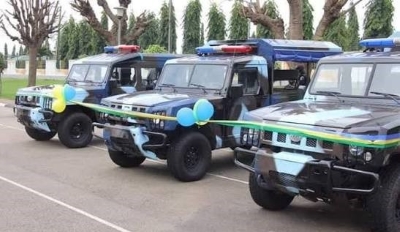
Tactical response units.
Pick-up trucks.
Sport utility vehicles (SUVs).
Armoured personnel carriers.
Command vehicles.
Utility trucks.
Ambulances.
Staff buses.
Recovery vehicles.
Surveillance units.
Motorcycles.
The list goes on.
And it doesn’t stop with vehicle procurement.
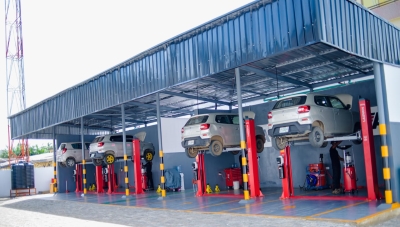
Each state police command would require workshops, maintenance facilities, spare parts inventories, tyres, batteries, fleet management systems, vehicle tracking technologies, communications equipment and technical support services.
The numbers are staggering.
Conservative estimates suggest that each state police command could require at least 500 operational vehicles and about 300 motorcycles during the initial rollout phase.
Multiply that across the 36 states and the FCT.
The result?
More than 18,700 operational vehicles.
Over 10,800 motorcycles.
Add tactical vehicles, support trucks, emergency response units and other operational assets, and total demand could exceed 30,000 vehicles within the first decade.
The financial implications are enormous.
At an average procurement cost of about ₦40 million per patrol vehicle and ₦5 million per motorcycle, the potential market value could reach between ₦1 trillion and ₦1.5 trillion.
And that excludes maintenance contracts.
Spare parts.
Tyres.
Insurance.
Fleet replacement programmes.
After-sales services.
For Nigeria’s automotive industry, this represents a once-in-a-generation opportunity.
According to the Director-General of the National Automotive Design and Development Council (NADDC), Otunba Joseph Osanipin, increased patronage of locally assembled vehicles remains critical to achieving sustainable automotive industrialisation in Nigeria.
Industry experts have long argued that no automotive manufacturing industry can survive without strong domestic institutional demand.
State police could provide exactly that.
A large.
Predictable.
Long-term market.
The critical question, however, is this:
Where will all these vehicles come from?
Fortunately, Nigeria already possesses substantial assembly capacity.
Local manufacturers and assemblers currently produce, or have the capacity to assemble, pick-up trucks, SUVs, passenger vehicles, buses, commercial vehicles, utility vehicles and motorcycles.
If policymakers introduce local content procurement requirements compelling state police commands to prioritise Nigerian-assembled vehicles, the impact could be revolutionary.
Assembly plants currently operating below capacity could experience explosive growth.
Fresh investments in component manufacturing could emerge.
Employment opportunities could expand dramatically.
Local supplier networks could flourish.
 And the benefits would extend far beyond vehicle assembly.
A nationwide state police programme could stimulate growth in tyre manufacturing, battery production, vehicle body building, automotive electronics, spare parts production, fleet management technologies, insurance, logistics, vehicle servicing and automotive financing.
The multiplier effect would be enormous.
Industry studies consistently show that every direct automotive manufacturing job creates several additional jobs across the wider economy.
Global experience supports this approach.
In the United States, thousands of state and local police agencies purchase domestically manufactured vehicles, helping sustain production by companies such as Ford and General Motors.
South Africa, India and Brazil have also leveraged government fleet procurement programmes to strengthen domestic automotive manufacturing and supplier development.
Ironically, the security benefits of state police could further accelerate automotive growth.
Better security means lower logistics costs.
Safer industrial facilities.
Stronger supply chains.
Increased investment.
And improved investor confidence.
For decades, Nigeria’s automotive industry has searched for the production volumes required for long-term sustainability.
That breakthrough may not come from another automotive policy.
Or another tariff adjustment.

Publisher/CEO, Motoring World International
Or another investment incentive.
It may come from somewhere entirely unexpected.
State police.
If properly implemented, the establishment of state police could become not only one of Nigeria’s most significant security reforms, but also the single biggest catalyst for the country’s long-awaited automotive industrial revolution.
©Copyright MOTORING WORLD INTERNATIONAL. All rights reserved. Materials, photographs, illustrations and other digital content on this website, may not be reproduced, published, broadcast, rewritten or redistributed in whole or in part without prior written permission from Motoring World International
Contact: editor@motoringworldng.com