OJO OLOTU
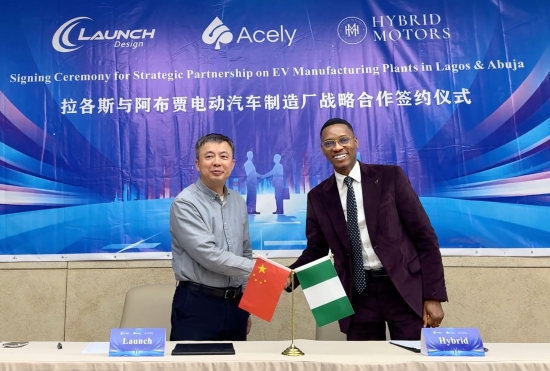
Nigeria’s automotive industry is set for a significant boost in electric mobility development following a landmark partnership between Launch Design Shanghai and Hybrid Motors Nigeria to establish electric vehicle manufacturing plants in Lagos and Abuja.
The high-profile agreement, signed in Shanghai on May 8, 2026, is set to power the production of “Acely”, Hybrid Motors Nigeria’s indigenous vehicle brand specifically engineered for Nigeria’s rugged roads, tropical climate and evolving mobility demands.
In what industry stakeholders are already describing as a game-changing development for Nigeria’s industrial future, the alliance combines Hybrid Motors Nigeria’s deep local market knowledge with Launch Design Shanghai’s global automotive engineering expertise.
At the heart of the ambitious project is a bold vision: building globally competitive electric and hybrid vehicles in Nigeria, by Nigerians, for Africa.
Speaking during the signing ceremony in Shanghai, the Chief Executive Officer of Hybrid Motors Nigeria, Mr. Jubril Arogundade, described the partnership as a defining moment in Nigeria’s automotive evolution.
“This partnership is more than a business agreement; it is a commitment to building Nigeria’s automotive future,” Arogundade declared.
“With Acely, we are proving that world-class vehicles can be conceived, designed and assembled right here in Nigeria, by Nigerians, for Nigerians.”
He added that the collaboration would inject world-class engineering standards directly into the company’s operations while preserving the brand’s Nigerian identity.
Also speaking, the Chief Executive Officer of Launch Design, Mr. Wang Xun, said the partnership represents a major opportunity to help shape Africa’s automotive manufacturing ecosystem.
“Launch Design is proud to partner with Hybrid Motors Nigeria in this transformative venture,” Wang said.
“Our turnkey engineering capabilities, combined with Hybrid Motors’ deep understanding of the Nigerian market, create a powerful formula for success. Together, we are not just building vehicles. We are building an industry.”
Under the strategic arrangement, both companies will establish dual manufacturing operations in Lagos and Abuja with a projected combined annual production capacity of 70,000 vehicles at full operational maturity.
The Lagos plant, strategically located along the booming Lekki-Epe corridor, will serve as the flagship production and assembly hub with an estimated annual capacity of 50,000 units.
Its proximity to the Lekki Deep Sea Port is expected to give the project a strong export advantage, positioning Nigeria as a potential electric vehicle supply base for West African markets including Ghana, Benin Republic, Togo and Côte d’Ivoire.
Industry observers believe the Lekki facility could become one of the most strategically positioned EV assembly operations in sub-Saharan Africa.
Meanwhile, the Abuja facility, planned for the Free Zone Business Area of the Centenary Economic City, will function as a secondary production and technology centre with a projected annual output of 20,000 units.
Beyond serving Northern Nigeria, the Abuja operation is also expected to target neighbouring Sahel markets while leveraging Free Zone incentives and Abuja’s strategic geographic location.
The companies disclosed that the dual-factory strategy would significantly cut logistics costs, improve operational efficiency and stimulate employment opportunities across multiple regions of the country.
Acely vehicles are expected to focus heavily on local assembly, energy efficiency and advanced mobility technologies tailored to Nigerian driving realities.
The project is also expected to accelerate the gradual adoption of electric and hybrid propulsion systems in line with global sustainability trends and Nigeria’s growing clean energy aspirations.
Automotive analysts say the partnership could trigger a fresh wave of investments across Nigeria’s automotive value chain by promoting local component manufacturing, technology transfer, technical training and skills development.
Experts further note that the initiative could help reduce Nigeria’s dependence on imported vehicles, conserve scarce foreign exchange and strengthen the country’s push to become a regional automotive manufacturing powerhouse.
The companies maintained that the project aligns strongly with the Federal Government’s National Automotive Industry Development Plan (NAIDP), aimed at deepening local vehicle production and attracting large-scale automotive investments into Nigeria.
For many industry watchers, however, the bigger headline may be this: Nigeria’s electric vehicle revolution is no longer a distant dream; the engines are already warming up.
©Copyright MOTORING WORLD INTERNATIONAL. All rights reserved. Materials, photographs, illustrations and other digital content on this website, may not be reproduced, published, broadcast, rewritten or redistributed in whole or in part without prior written permission from Motoring World International
Contact: editor.motoringworldng@motoringworldng.com