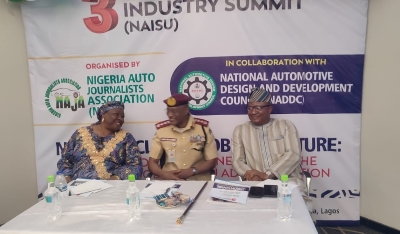
L-R: NADDC’s Director of Public Relations, Mrs. Susan Taiwo; representing the council’s Director-General, FRSC’s Corps Marshal, Shehu Mohammed and Deputy Managing Director, CFAO Mobility, Mr. Kunle Jaiyesimi, during the 3rd Nigeria Auto Industry Summit (NAISU) held in Lagos on Thursday, July 30, 2026
The National Automotive Design and Development Council (NADDC) and the Federal Road Safety Corps (FRSC) have intensified calls for accelerated investment, stronger regulation and enhanced safety measures to fast-track Nigeria’s transition to electric vehicles (EVs) and Compressed Natural Gas (CNG)-powered transportation.
Speaking at the 3rd Nigeria Auto Industry Summit (NAISU) organised by the Nigeria Auto Journalists Association (NAJA) in Lagos, NADDC urged private investors to bridge the country’s infrastructure gap by establishing more CNG refuelling stations and EV charging points across Nigeria.
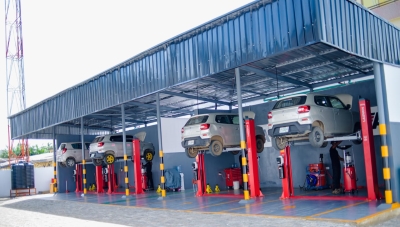
Representing the Director-General of NADDC, the Council’s Director of Public Relations, Mrs. Susan Taiwo, disclosed that 345 CNG conversion centres have already been certified nationwide, describing the milestone as a major step in promoting safe and standardised gas-powered mobility.
She noted that while the council has laid a solid foundation for clean transportation over the past two decades, inadequate refuelling and charging infrastructure remains a major obstacle to wider adoption of EVs and CNG vehicles.
According to Taiwo, Nigeria needs significant private sector investment to ensure motorists can conveniently access CNG and EV charging facilities without the long queues and range anxiety currently limiting the growth of clean mobility.
She recalled that NADDC championed electric vehicle development long before the technology gained popularity in Nigeria, including supporting the introduction of the Hyundai Kona EV despite widespread scepticism over the country’s electricity supply.
Taiwo maintained that expanding clean energy infrastructure would not only drive the automotive industry’s growth but also reduce carbon emissions, lower vehicle operating costs and improve public health.
Also speaking at the summit, Corps Marshal of the Federal Road Safety Corps, Shehu Mohammed, reaffirmed the agency’s commitment to ensuring that Nigeria’s migration to EVs and CNG-powered vehicles is underpinned by world-class road safety standards.
He said the emergence of alternative-fuel vehicles demands new safety regulations, specialised training, updated operational procedures and closer collaboration among regulators, manufacturers, conversion centres and transport operators.
The Corps Marshal stressed that FRSC is already strengthening its operational framework to address the unique safety requirements of electric and CNG-powered vehicles while supporting the Federal Government’s clean mobility agenda.
He added that the success of Nigeria’s clean transport revolution will depend on sustained collaboration among government agencies, industry stakeholders and private investors to deliver safer roads, cleaner air and long-term economic benefits.
©Copyright MOTORING WORLD INTERNATIONAL. All rights reserved. Materials, photographs, illustrations and other digital content on this website, may not be reproduced, published, broadcast, rewritten or redistributed in whole or in part without prior written permission from Motoring World International
Contact: editor@motoringworldng.com