YEMI AROGUNDADE
For decades, Nigeria’s automotive market has run on one fuel – cash. From Lagos showrooms to roadside dealers, buyers either paid upfront or walked away. But now, a new force is entering the system, one that could upend everything: structured consumer credit.
At the heart of this shift is the Nigerian Consumer Credit Corporation (CREDICORP), a bold federal intervention designed to unlock financing for everyday Nigerians. For an industry long suffocated by low purchasing power, it sounds like the breakthrough moment stakeholders have been waiting for.
But beneath the optimism lies a more complicated question: Can this credit revolution truly ignite Nigeria’s auto industry, or will it become another well-meaning policy with limited traction?
Industry insiders have always been clear about one thing: without financing, there is no mass market. As Jelani Aliyu, former Director-General of the National Automotive Design and Development Council, once put it, “You cannot build a sustainable car market on cash purchases alone. Credit is what drives volume globally.”
CREDICORP appears to be a direct response to that reality. By enabling Nigerians to spread payments over time, it has the potential to dramatically expand the pool of car buyers. For local manufacturers like Innoson Vehicle Manufacturing, Mikano, CFAO, Kia, Carloha, Coscharis, Stallion, and a host of other assembly plants, that could mean one thing – volume. And in the auto business, volume is everything.
Imagine a Nigeria where salaried workers can walk into a dealership, make a modest down payment, and drive out in a brand-new locally assembled car. That is the promise. And if it materializes, it could finally reduce the country’s overwhelming dependence on imported used vehicles.
Economic voices have long argued that credit is the missing ignition key. Muda Yusuf, former Director-General of the Lagos Chamber of Commerce and Industry, has consistently maintained that “when you deepen consumer credit, you stimulate demand across sectors.” The auto industry, with its high-ticket products, stands to gain the most.
But here’s the catch. Nigeria’s reality is unforgiving.
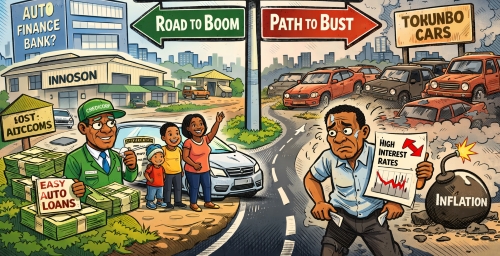
Interest rates remain punishing. Loan structures are short-term. And risk pricing is still high. As the late Herbert Wigwe, former Group Managing Director/CEO of Access Bank Plc, once warned, “Auto loans in Nigeria are still priced like unsecured risk.” That single sentence captures the dilemma: credit exists, but at a cost many cannot bear.
And then comes the bigger structural flaw, talking about focus.
CREDICORP is not an auto finance institution. It is a broad consumer credit system, competing across multiple needs, including : housing, electronics, personal consumption. The automotive sector, despite its economic importance, is just one of many priorities. That dilution could prove costly.
This is why many industry stakeholders still look back at the yet-to-be-passed NAIDP (Nigeria Automotive Industry Development Plan) with a sense of “what could have been.” Embedded in that policy was the idea of an Auto Finance Bank, a dedicated institution designed specifically to fund vehicle purchases, particularly locally assembled units.
The difference is strategic. While CREDICORP spreads credit across the economy, an Auto Finance Bank would have channeled it with precision-directly into factories, dealerships, and Nigerian-made vehicles.
As Aminu Jalal, former Director-General of NADDC, had long emphasized, “Without accessible and structured auto finance, local assembly will continue to struggle.” A specialized bank could have tied financing to policy, ensuring that every loan strengthens domestic production.
Instead, Nigeria now has a more generalized tool, which is powerful, but potentially blunt.
Other risks include: weak credit culture, limited borrower data and enforcement challenges. Add to that inflation and exchange rate volatility, and the price of vehicles continues to climb, sometimes faster than credit can compensate.
Even at the retail level, skepticism remains strong. Buyers still lean toward older “tokunbo” vehicles, where the financial commitment feels safer and immediate.
Yet, despite all the doubts, something fundamental has changed. Nigeria is, slowly but surely, entering its credit era.
CREDICORP may not be perfect. It may not be enough. But it is a signal, a declaration that the days of a purely cash-driven auto market are numbered.
The real question now is not whether credit will shape Nigeria’s auto industry. It will.
The question is whether it will be structured well enough to save it… or flawed enough to stall it.