ANNIE ALLEN (UK Bureau Chief)
A quiet revolution is unfolding on South Africa’s roads. And it is coming from China.
Lower-cost Chinese vehicles are flooding the market at a pace that is no longer ignorable, redrawing the country’s automotive landscape and forcing a high-stakes rethink of industry survival strategies.
For consumers, it feels like a breakthrough. For the industry, it could be a warning signal.
Data from the National Association of Automobile Manufacturers of South Africa (Naamsa) reveal that Chinese brands have surged to capture over 9 percent of total new passenger vehicle sales in 2024, up sharply from barely noticeable levels just a few years ago.
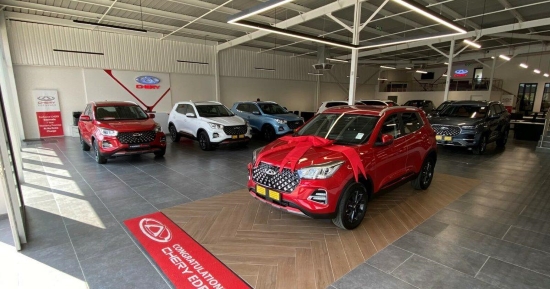
Brands like Chery, Haval and BAIC are no longer fringe players. They are now aggressively mainstream, offering brand-new vehicles at prices that once belonged to the used car market.
That shift is seismic. Suddenly, buyers who would typically settle for pre-owned vehicles are stepping into showrooms for brand-new options: packed with features, backed by warranties, and increasingly supported by attractive financing deals.
“It’s changing the affordability equation,” analysts note.
And in the short term, that is good news. Motor finance is getting a boost. Dealership activity is picking up. Consumers are enjoying more choice at lower entry points.
But beneath the surface, the tremors are spreading. South Africa’s automotive sector is not just another retail market; it is a cornerstone of the economy: a major employer, a manufacturing hub, a key export engine.
And now, it is under pressure. The rise of Chinese brands is exposing deeper structural weaknesses, high production costs, logistics inefficiencies, and a broader competitiveness gap that local manufacturers must now confront head-on.
This is not just about cheaper cars. It is about faster, smarter, and more integrated competitors.
Chinese automakers are leveraging scale, supply chain dominance, and rapid innovation cycles to outpace traditional players. In many segments, they are no longer “budget alternatives”, they are credible, compelling choices.
That raises a critical question: Can South Africa’s domestic auto industry keep up?
The instinctive response, raise import duties, may seem tempting. But experts warn that could backfire.
Tariffs may shield local manufacturers temporarily, but they would also drive up prices for already strained consumers, weaken competitive pressure, and delay the reforms the industry urgently needs.
More importantly, tariffs do not fix the real problem. South Africa’s competitiveness challenges run deeper : logistics bottlenecks, infrastructure gaps, cost pressures, and evolving global technology demands. These cannot be solved at the border.
What is unfolding, analysts argue, is not just a market shift; it is a stress test.
A test of whether South Africa can build an automotive ecosystem strong enough to compete in a rapidly changing global landscape.
Because the reality is stark: Consumers are winning, for now. But the industry is at a crossroads.
The surge of Chinese imports has created a delicate balancing act between affordability and industrial sustainability, between open competition and strategic protection.
The temptation will be to fight the tide. But the smarter play may be to adapt to it.
South Africa’s auto market is being reshaped in real time. The question is no longer whether Chinese brands will stay; it is whether the local industry can evolve fast enough to survive their rise.
©Copyright MOTORING WORLD INTERNATIONAL. All rights reserved. Materials, photographs, illustrations and other digital content on this website, may not be reproduced, published, broadcast, rewritten or redistributed in whole or in part without prior written permission from Motoring World International
Contact: editor.motoringworldng@motoringworldng.com