

Nigeria’s automotive sector is being held hostage. Not by foreign competitors, not by lack of talent, not by absence of investors. But by the failure of our lawmakers to do the most basic thing: pass the National Automotive Industry Development Plan (NAIDP) Bill into law.
For more than ten years, a policy designed to industrialize Nigeria, create jobs, protect consumers, and attract manufacturing investment has been allowed to drift in bureaucratic purgatory. Meanwhile, our neighbouring countries are signing manufacturing deals, expanding export hubs, and positioning themselves for the future of mobility. Nigeria, Africa’s largest economy, is still debating whether to formalise a policy that should have been law yesterday.
This hesitation is not harmless. It is costing the country billions—and costing Nigerians their livelihoods.
Nigeria Is Losing the Automotive Race
While our National Assembly procrastinates, countries like Morocco and South Africa have secured partnerships with some of the world’s biggest automakers. Why? Because their industrial policies are not mere memos. They are laws. Stable. Predictable. Bankable.
Nigeria’s NAIDP remains a “policy at the mercy of political changes,” and investors are not fooled. They will not commit long-term capital to a country that cannot guarantee long-term rules.
A Nation Bleeding Jobs
Every year, we import hundreds of thousands of used cars—vehicles that create jobs in other countries while destroying opportunities at home. Each container that arrives through our ports is a reminder of what we have refused to build.
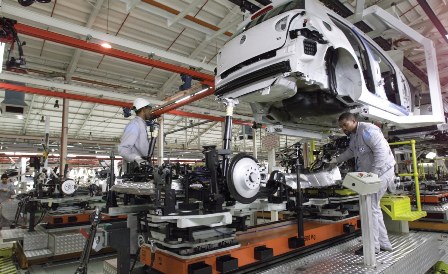
Local automotive assembly plants are operating far below capacity. Many are downsizing. Some have quietly exited. Why? Because without a legislated NAIDP, there is no incentive to produce locally, no protection, and no clear future.
Nigeria is not just missing opportunities. We are actively exporting jobs.
By refusing to pass the NAIDP, lawmakers have effectively opened Nigeria’s borders to every type of automotive scrap the world no longer wants. Nigerians are driving vehicles that would never be allowed on the roads of Europe, Asia, or North America.
Without enforceable laws, substandard imports continue to flood our markets. Unsafe. High-emission. Unregulated. And deadly.
Let’s be blunt: No serious automotive manufacturer will invest in a country where industrial policy expires with the term of each minister. Investors need legal certainty, not political mood swings.
Every year the NAIDP Bill is delayed, Nigeria loses credibility. Once lost, it is far harder—and far more expensive—to regain.
This is not merely a sectoral legislation. It is a national economic emergency. The NAIDP Bill has bipartisan support. Industry support. Public support. Government agency support. It is perhaps the only economic policy in Nigeria that everyone agrees on—except those whose signatures are required to make it law.
If lawmakers allow another year to pass without action, they will shoulder the responsibility for sabotaging one of the most promising industrialisation opportunities in Nigeria’s modern history.
Enough Excuses. Enough Delays. Enough Waste.
Nigeria cannot diversify its economy while remaining dependent on imported vehicles.
Nigeria cannot create manufacturing jobs without a legislative foundation.
Nigeria cannot protect consumers without enforceable standards.
Nigeria cannot attract investors without legal certainty.
Nigeria cannot modernise mobility while standing still.
The NAIDP Bill is not a luxury. It is not optional. It is not “something to consider.” It is the backbone of Nigeria’s automotive future.
Motoring World demands immediate passage of the NAIDP Bill.
Not next month. Not next session. Not after another round of committees.
NOW.
History will remember those who acted—and those who failed to.
