

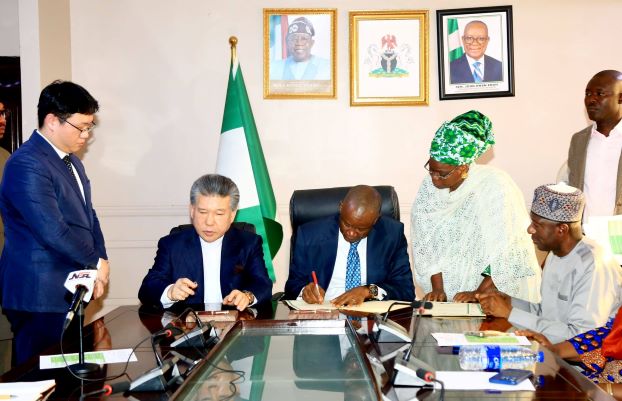
In a move that could redraw Africa’s industrial map, Nigeria has taken a bold step toward becoming the continent’s first electric vehicle (EV) manufacturing nation, signing a landmark agreement with South Korea’s Asia Economic Development Committee (AEDC) to establish a large-scale EV manufacturing plant and nationwide charging infrastructure.
The Memorandum of Understanding (MoU), signed in Abuja by the Federal Government through the Federal Ministry of Industry, Trade and Investment (FMITI), signals a decisive shift from Nigeria’s long-standing role as a vehicle-importing nation to an emerging hub for clean automotive manufacturing.
At the heart of the deal is a two-phase industrial plan that begins with a complete EV assembly plant and progresses to full in-house vehicle production, including key components. When fully operational, the facility is projected to produce up to 300,000 electric vehicles annually and create about 10,000 direct jobs, with thousands more expected across the supply chain.
Beyond the factory gates, the project aims to tackle one of Nigeria’s biggest economic leaks: fuel imports. With the country spending an estimated $10 billion annually on refined petroleum products, officials say mass EV adoption could significantly reduce pressure on foreign exchange while accelerating industrial diversification.
Government officials described the MoU as a practical expression of Nigeria’s National Energy Transition Plan (ETP) and the National Automotive Industry Development Plan (NAIDP)—two flagship policies designed to build a sustainable, technology-driven economy.
By integrating EV manufacturing with charging infrastructure development, the initiative seeks to create a complete electric mobility ecosystem, spanning auto parts, battery technology, charging solutions and vehicle maintenance services.
Speaking at the signing ceremony, AEDC Chairman, Yoon Suk Hun, pledged long-term commitment to Nigeria’s automotive future, framing the project as a historic acceleration of industrial growth.
Drawing from South Korea’s own development journey, Yoon said the ambition is to elevate Nigeria’s automotive industry to world-class standards within 20 to 30 years, a transformation that took advanced economies over a century to achieve.
The Minister of State for Industry, FMITI, Senator John Owan Enoh, reaffirmed the Federal Government’s full backing, pledging close coordination with AEDC to fast-track the project’s execution. He described the initiative as a cornerstone of President Bola Ahmed Tinubu’s “Nigeria First Policy”, which prioritizes local production, value addition and industrial self-reliance.
According to the Minister, the EV project represents more than a factory; it is a statement of intent that Nigeria is ready to compete in future-facing industries.
The National Automotive Design and Development Council (NADDC) disclosed that the partnership will prioritize technology transfer, human capital development, research and vehicle design, ensuring Nigerian engineers and technicians are embedded at every stage of the value chain.
The Council noted that Nigeria had already laid the groundwork through its EV development policy, which has enabled the introduction of electric vehicles, some locally assembled, into the market.
If successfully executed, the project could reposition Nigeria from a consumer of imported technologies to a producer of high-value, green industrial products, powered by renewable and transitional energy sources.
For Africa’s largest economy, the message is unmistakable: the electric future is no longer coming. It is being built, and Nigeria wants to lead it.

