

ANNIE ALLEN (EU Correspondent)
Euro NCAP has released the results of its biggest safety test of the year. And the verdict is clear: 2025 is shaping up to be one of the safest years yet for new cars.
Twenty-three fresh models, spanning electric SUVs, luxury coupés, crossovers, and family haulers, have been put through the organisation’s toughest crash tests ahead of stricter assessments coming in 2026. Impressively, 18 of these newcomers clinched the coveted five-star rating, but as Euro NCAP warns, the real story lies deeper in the numbers.
Euro NCAP’s 2025 line-up features one of the widest vehicle selections yet, reflecting shifting consumer tastes and the rapidly expanding EV market. While many vehicles now achieve a five-star rating, what truly separates the leaders from the rest are the percentage scores across the programme’s four categories: Adult Occupant Protection, Child Occupant Protection, Vulnerable Road User Protection, and Safety Assist. These scores offer clearer insight into how each car performs in real-world crash scenarios and how effectively its safety technologies prevent collisions.
Standout Performers
Adult safety continues to be a strong point for modern vehicles, and the 2025 results reaffirm this trend. Nine of the 23 cars scored 90 percent or higher in Adult Occupant Protection — a critical measure of how well a car safeguards both front and rear passengers. Euro NCAP’s assessment includes two frontal crash tests, a side-impact test, and a pole test using different sizes of crash dummies to mimic real-world occupant diversity.
Leading the pack with an impressive 93 percent were the Leapmotor B10, the Mercedes-Benz CLE Coupé, and the Hongqi EHS7 — all securing five-star ratings. The popularity of mid-size SUVs also meant strong representation in this category, with models such as the Kia EV5, Nissan Qashqai, Škoda Elroq and Enyaq, Subaru Solterra, Toyota bZ4X, and the refreshed Tesla Model Y undergoing evaluation.
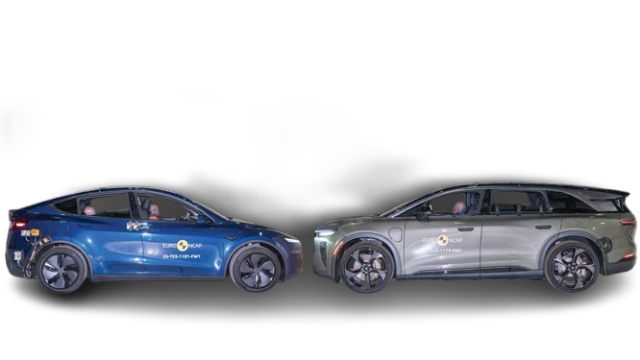
Among them, the Tesla Model Y stood out, scoring 91 percent for Adult Occupant Protection and a remarkable 93 percent for Child Occupant Protection, along with high marks for its driver assistance systems.
Large SUVs and Premium Models
Volvo lived up to its safety reputation with the EX90, a seven-seat electric SUV that delivered exceptional results: 92 percent for Adult Occupant Protection, 93 percent for Child Occupant Protection, and 86 percent for Safety Assist. Although Volvo recently announced that LiDAR will become optional on this model, Euro NCAP clarified that LiDAR had no influence on the tested vehicle’s safety outcome. A comparison with the previously tested Polestar 3 — which lacked LiDAR — showed nearly identical results.
Also tested in the large-SUV class were the Lucid Gravity and MG MGS9 PHEV. Both achieved an adult safety score of 83 percent, but the Gravity distinguished itself with a strong 93 percent rating for child occupant protection. All three received five-star ratings.
Mid-Size Sedans and Crossovers
The BYD SEAL 6 also impressed, scoring 92 percent for Adult Occupant Protection and performing strongly in active safety technologies. Its segment rival, the BMW 2 Series Gran Coupé, earned respectable marks but slipped to a four-star overall rating due to a modest 78 percent adult protection score.
 In the hatchback and crossover categories, CUPRA, SEAT, Toyota, and Volkswagen were represented. The CUPRA Formentor emerged as a standout performer with a 91 percent adult protection score, while the VW ID.3 shone with an 87 percent score for child safety.
Volkswagen’s Multivan and Caddy — both family-oriented people carriers — received four-star ratings.
A Safer Market Than Ever
Euro NCAP says the results show manufacturers continuing to push for all-round excellence in safety. While sub-par cars still exist, the organisation notes that consumers today have more genuinely safe options than ever before.
According to Dr. Aled Williams, Euro NCAP’s Programme Director, car buyers should begin with the overall star rating but then look deeper: “The individual scores provide a more nuanced overview of how one car outperforms another,” he said. “That’s where the real insight lies for consumers researching their next car.”
©Copyright MOTORING WORLD INTERNATIONAL.
All rights reserved. Materials, photographs, illustrations and other digital content on this website, may not be reproduced, published, broadcast, rewritten or redistributed in whole or in part without prior written permission from Motoring World International
Contact: editor.motoringworldng@gmail.com
