

FEMI OWOEYE
Nigeria’s automotive industry entered 2025 weighed down by familiar burdens – policy uncertainty, a fragile manufacturing base, forex volatility and deep infrastructure gaps. For much of the year, the sector seemed trapped in a cycle of stalled reforms and missed opportunities.
Yet, as 2025 draws to a close, a long-awaited policy shift has injected cautious optimism into an industry starved of clarity.
For most of the year, the industry’s greatest pain remained the failure to pass the National Automotive Industry Development Policy (NAIDP) into law.
Dr. Sam Faleye, President and CEO of SAGLEV Electromobility, had been blunt: without NAIDP, “true industrialization is impossible.” He warned that Nigeria’s existing framework still favours used-vehicle importation over local value creation, assembly depth and component manufacturing.
Former Acting Director-General of the National Automotive Design and Development Council (NADDC), Luqman Mamudu, reinforced that view, noting that fiscal measures introduced in recent years failed to address the core NAIDP objective of building sustainable local capacity. Assembly plants established between 2014 and 2020, he argued, were effectively sidelined under current programmes.
However, a significant late-year development altered the narrative. The Federal Executive Council’s (FEC) approval of the Nigeria Industry Policy (NIP) formally positioned it as the country’s overarching industrial framework, a move widely seen as creating the legal and strategic runway for the long-delayed Auto Policy to finally become law.
Speaking at the 18th Nigeria Auto Journalists Association (NAJA) International Auto Awards in Lagos, the Minister of State for Industry, Senator John Enoh, said the approval signals a deliberate shift towards sectors capable of delivering scale jobs, technology transfer and value-chain development, with automotive manufacturing identified as a priority.
Represented by NADDC Director-General, Otunba Oluwemimo Joseph Osanipin, the minister said the next critical step is the enactment of the National Auto Policy by the National Assembly.
“The Nigeria Industry Policy has been approved by the Federal Executive Council and now guides Nigeria’s industrial development,” Osanipin said. “The next step is to enact the Auto Policy into law. These are deliberate actions to ensure the automotive sector receives the attention and priority it deserves.”
Operational and Economic Pressures Persist
Despite the policy optimism, operational realities remained harsh throughout 2025.
Assemblers endured costly delays arising from the rocky implementation of the B’Odogwu customs platform, while the sudden introduction of a 4 per cent FOB levy further inflated import costs for manufacturers already battling forex instability.
With SKD and CKD kits sourced in foreign currency, pricing volatility became a major risk. “You can easily sell at a loss,” Faleye warned.
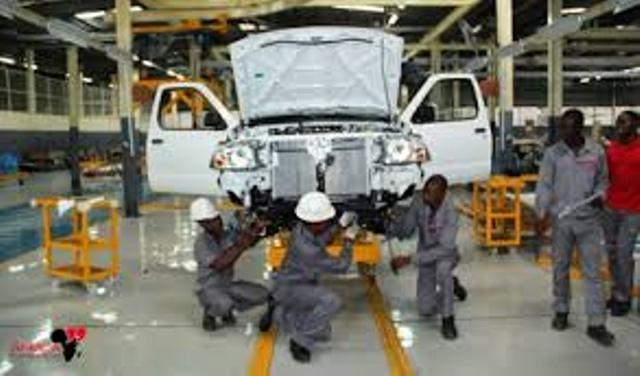
Port congestion, unreliable power supply and high logistics costs continued to push production expenses upward. Even with repeated government assurances on localisation, execution lagged behind intent. Most assemblers, Faleye noted, still operate far below installed capacity, while the components ecosystem remains largely undeveloped.
Government patronage, historically a stabilising force for local assembly, also failed to gain traction in 2025. “We have not seen much support from MDAs,” Faleye said, a concern echoed by Mamudu, who added that when procurement does occur, volumes are too small to drive industrial scale.
Gains: Alternative Fuels and Policy Signals
Against this backdrop, 2025 delivered notable gains, particularly in alternative-fuel mobility.
With petrol subsidy removed, adoption of compressed natural gas (CNG) and electric vehicles accelerated, especially among fleet operators, logistics companies and higher-income retail buyers. Charging infrastructure for EVs expanded slowly but steadily, while interest in CNG-powered fleets rose sharply.
“It’s not just talk; it is real,” Faleye said, noting a clear shift in consumer behaviour among buyers who can afford new vehicles.
Customs authorities also stabilised document processing under the B’Odogwu system after early disruptions, offering some relief to assemblers who lost time and capital earlier in the year.
CNG infrastructure, however, remains a bottleneck. Mamudu disclosed that Pi-CNG is reviewing its rollout strategy, warning that adoption will remain limited without incentives for factory-built CNG vehicles rather than conversions.
Government Draws the Line on Used Vehicles
Perhaps the strongest policy signal of the year came from government’s increasingly aggressive stance against used vehicle imports.
Osanipin revealed that the Federal Government is deliberately tightening entry standards to curb the influx of second-hand vehicles, gradually shifting demand toward locally assembled and manufactured alternatives. Central to this effort is the NAIDP, which NADDC is targeting for passage into law by the second quarter of 2026.
“We are committed to strengthening local manufacturing in Nigeria,” Osanipin said. “Our major target is to see the Auto Policy enacted by mid-2026, with extensive stakeholder engagement during the legislative process.”
This push is reinforced by the End-of-Life Vehicle (ELV) Recycling Regulation introduced in March 2025, aimed at formalising vehicle recycling, promoting a circular economy, improving road safety, protecting the environment and creating new jobs. For industry players, the regulation also signals a gradual tightening of the used-vehicle ecosystem that has long dominated Nigeria’s market.
What NAIDP Could Unlock
If enacted, the NAIDP is expected to bring long-overdue clarity on tariffs, fiscal incentives, local content thresholds and vehicle standards-areas that have repeatedly stalled investment and left Nigeria trailing peers such as South Africa, Morocco and Egypt.
More importantly, stakeholders believe the policy could shift the industry from low-value assembly to deeper localization- components, wiring harnesses, tyres, plastics, batteries and body panels- where jobs, skills and foreign exchange savings are concentrated.
The timing also aligns with Nigeria’s transition to cleaner mobility. With P-CNG positioned as a near-term solution and EV adoption gaining traction, a coherent auto policy could provide the framework for structured entry into EV assembly, battery development and charging infrastructure.
Nigeria’s auto industry in 2025 took a few meaningful steps forward. And for the first time in years, policy signals suggest those steps may not be reversed. The pains remain deep and structural, but the gains are no longer isolated sparks.
The approval of the Nigeria Industry Policy and government’s declared war on used vehicles has raised expectations across the sector. The test now lies with the National Assembly and the speed at which intent is translated into law, implementation and measurable industrial output.
The industry has shown what is possible. What it needs now is not more speeches or pilot schemes, but follow-through and political courage. If NAIDP finally becomes law, 2025 may yet be remembered not as another year of hesitation, but as the moment Nigeria’s auto industry finally found its footing.
For now, the verdict stands: the gains are beginning to glow. But the pains have not yet gone quiet.
©Copyright MOTORING WORLD INTERNATIONAL
All rights reserved. Materials, photographs, illustrations and other digital content on this website, may not be reproduced, published, broadcast, rewritten or redistributed in whole or in part without prior written permission from Motoring World International
Contact: editor.motoringworldng@gmail.com

